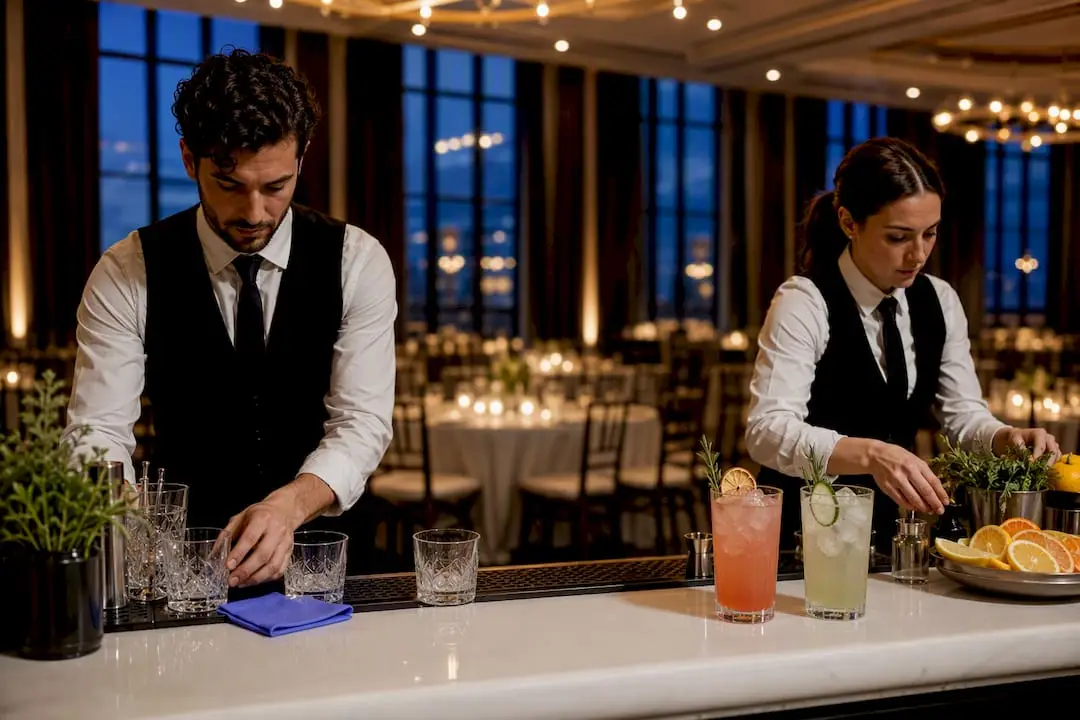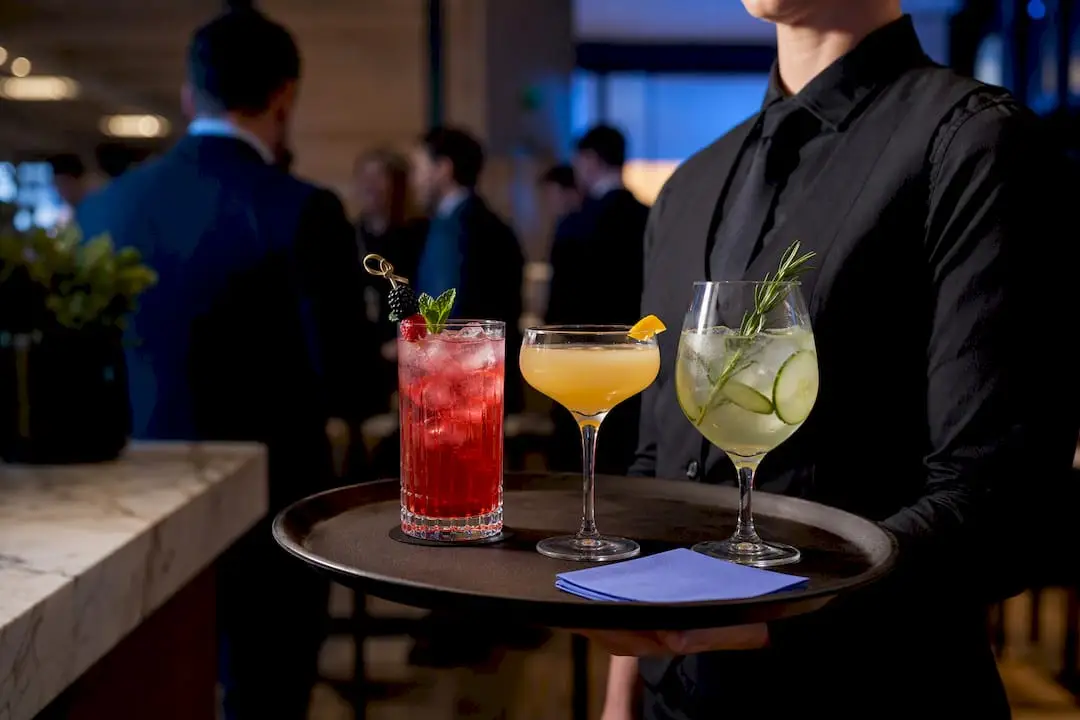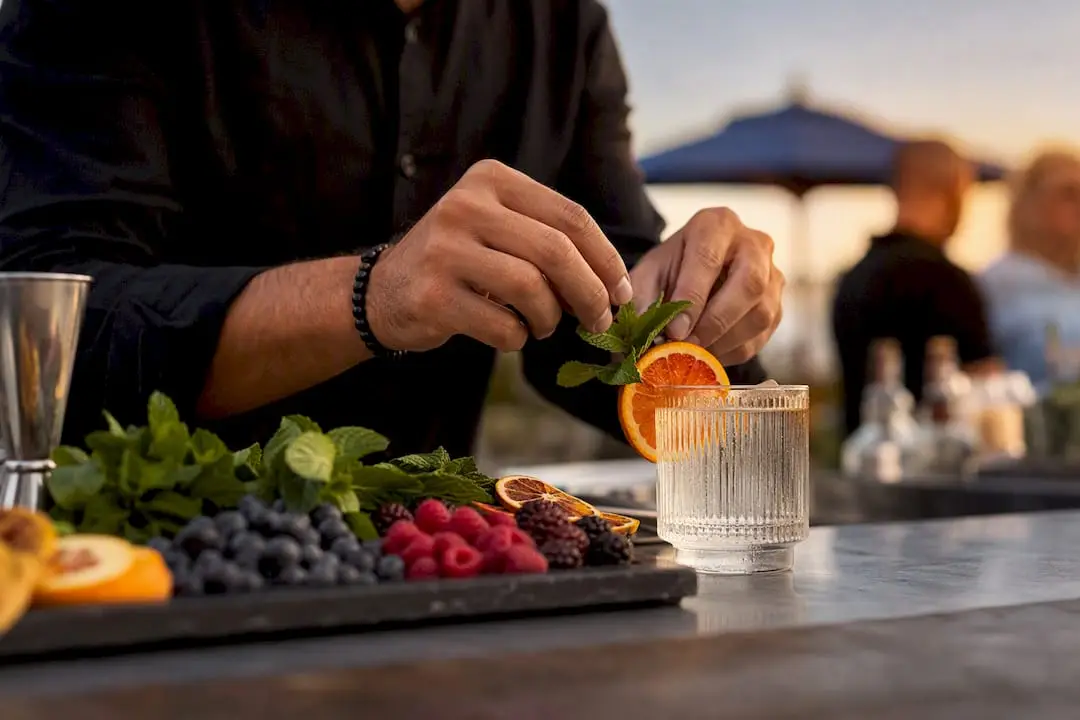
One drink needs one large element (a wheel, wedge, or twist) or one herb sprig plus one to three small accents like berries or a cherry. Fruit-heavy garnishes get three to five small pieces per glass. That’s it. That’s the whole rule most bartenders overcomplicate.
For events, plan garnish quantities per guest per hour rather than per drink, since guests order multiple rounds. A standard two-hour service runs roughly a couple of citrus wedges and a couple of mint sprigs per guest, scaled up from there for longer events. Build in a modest waste buffer for trimming, bruising, and the occasional dropped lime wheel, based on the same logic Miss Vickie’s batch planning guide uses for alcohol and ice.
A few exceptions matter:
- Spirit-forward, “up” cocktails (Martinis, Manhattans) typically take just one twist or one cherry, since the drink is meant to be clean and aromatic, not decorated.
- Highballs and long drinks (Mojitos, Moscow Mules) can carry a sprig plus a wedge, since there’s more surface area and dilution to balance.
- Frozen or blended drinks often skip garnish weight entirely in favor of a single rim treatment, or one small fruit piece for color.
Key Takeaways
| Point | Details |
|---|---|
| Default per-drink rule | Use one large element (wheel, wedge, twist) or one sprig plus one to three small accents. |
| Match format to drink style | Twists suit aroma-first cocktails; wedges suit interactive drinks; wheels suit visual presentation. |
| Scale by guest hours, not guest count alone | Multiply per-guest, per-hour garnish needs by total service length before ordering. |
| Build in a waste buffer | Add 15 to 20% to every garnish quantity to cover trimming, bruising, and demand spikes. |
| Time prep to shelf life | Cut delicate herbs and citrus close to service; prep dehydrated or jarred garnishes days ahead. |
Table of Contents
- What Garnish Quantities Actually Do to a Drink
- How Much of Each Garnish Type Should You Use?
- How Do You Scale Garnish Quantities for Events?
- When Should You Prep, Store, and Rotate Garnishes?
- What Does Garnish Actually Cost Per Drink?
- What Are the Best Low-Waste Garnish Practices?
- How Does Cocktail Crew Apply This in Real Events?
- Selected External Guides, Calculators, and Internal Tools
- Why Exact Garnish Counts Beat “Garnish to Taste”
- Sources
What Garnish Quantities Actually Do to a Drink
A garnish isn’t decoration bolted onto a finished cocktail. It’s a fifth ingredient, and how much of it you use changes the drink in four distinct ways: aroma, flavor, texture, and visual weight. Miss the distinction and you’ll either over-garnish a drink into a fruit salad or under-garnish one into a bland pour.
Aroma comes first because it’s what a guest smells before the first sip, and it shapes taste perception before the liquid ever touches the tongue. A citrus twist works almost entirely through aroma. Twisting the peel over the glass releases oils that guests smell with every sip, which is why one twist is plenty. Two twists doesn’t double the aroma. It just muddies it.
Flavor is what citrus wedges and wheels add through direct contact and squeezing. A lime wedge dropped into a Gin and Tonic changes the acidity if a guest squeezes it, so quantity here is really about how much the drinker controls the final taste.
Texture shows up with muddled herbs, crushed berries, or a briny olive. A mint sprig that’s been slapped (not muddled) between the palms releases aroma without adding bitterness, while over-muddling turns the same sprig into a source of unwanted vegetal bite.
Visual weight is the one bartenders overdo most. A single, well-placed dehydrated lime wheel says more than three wedges piled on a rim.
Here’s the sequence that keeps garnish quantity intentional rather than habitual:
- Echo the drink’s core flavor (a lime wheel on a Margarita repeats the lime already in the glass).
- Contrast when the drink needs balance (a bright citrus twist against a rich, spirit-forward Old Fashioned).
- Keep proportion so the garnish never overwhelms the glass. A three-rule pairing logic like this is what separates a garnished drink from a decorated one.
Pro Tip: If you’re unsure whether a cocktail needs one garnish element or two, taste it first without any garnish. If the drink is already balanced, add only what enhances aroma. If it tastes flat, that’s your cue for a contrasting element, not more of the same one.
How Much of Each Garnish Type Should You Use?
Precise per-drink counts by garnish only take you so far without knowing which format fits which cocktail. Here’s the practical breakdown bartenders actually use behind the bar.
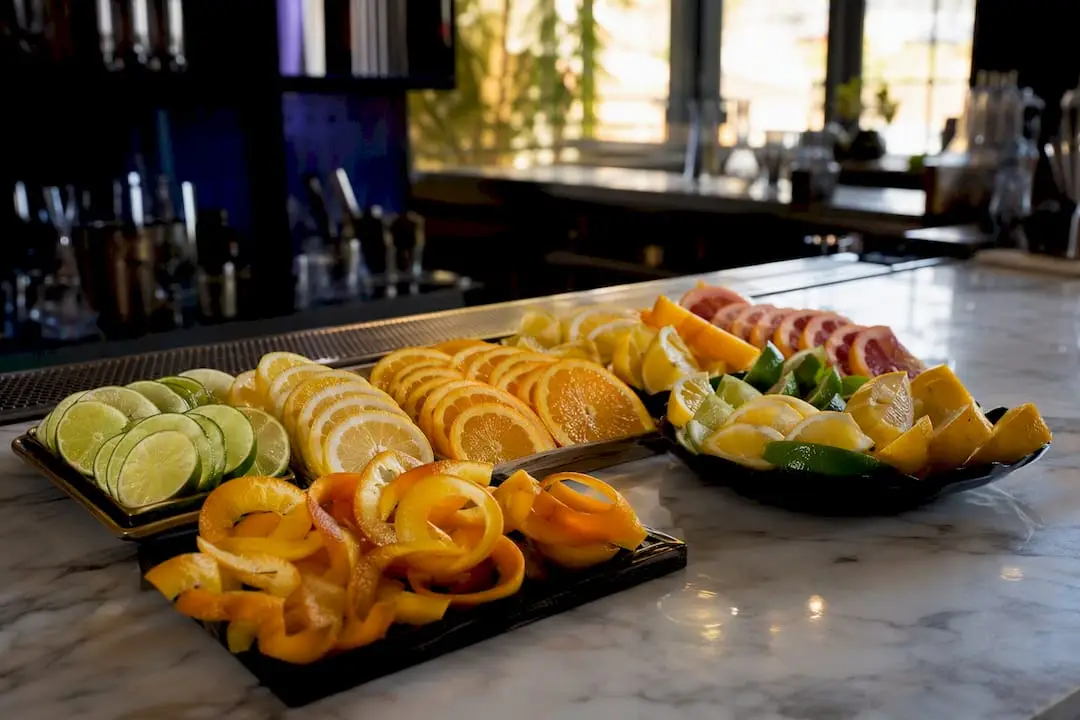
Citrus wheels, wedges, and twists are the most common garnish family, and each format serves a different purpose. A wheel (a full round slice, often 3 to 5mm thick) is best for drinks served in a rocks glass or Collins glass, where it can float or lean against the rim, one per drink. A wedge is for interactive drinks, where the guest is expected to squeeze it, also one per drink. A twist is reserved for aroma-first cocktails and calls for a wider strip of peel, twisted directly over the drink to release oils, then either dropped in or rubbed along the rim. Expect roughly 8 to 10 usable wheels or wedges per standard lime and closer to 10 to 12 per lemon, depending on size and how much pith you trim.
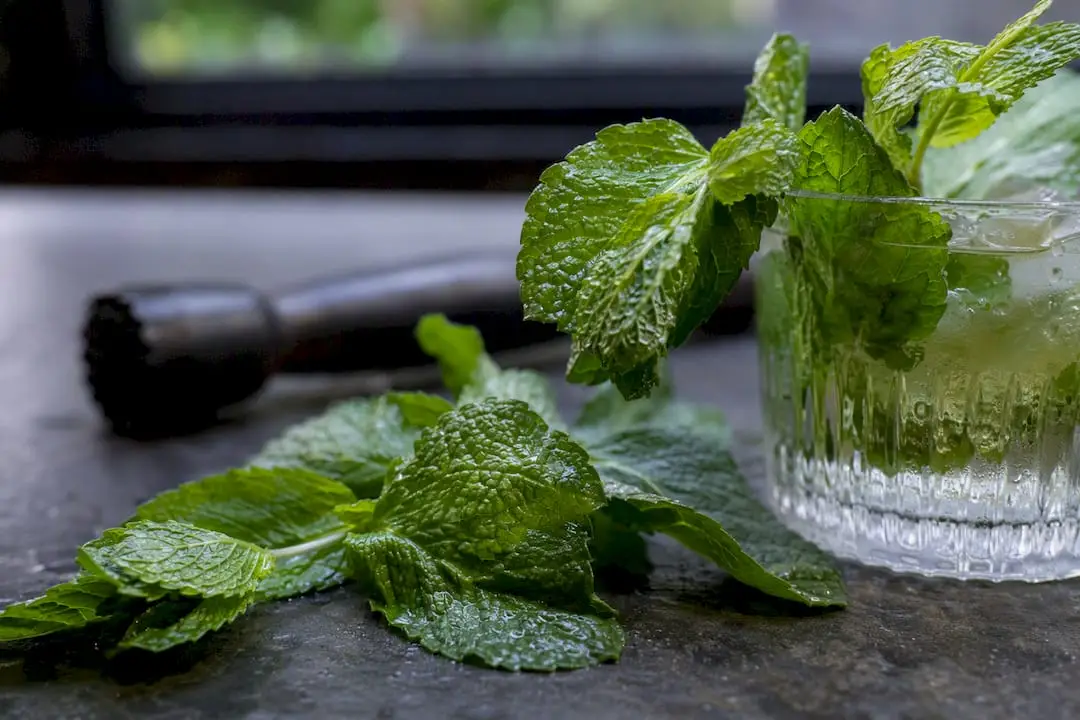
Herbs follow a tighter rule: one sprig per drink, made up of three to five leaves. More than that and you’re adding bitterness without adding proportional aroma. If a recipe calls for muddled mint, as in a Mojito, that sprig gets bruised in the shaker or glass, but a second sprig, fresh and unmuddled, goes on top purely for aroma and presentation. That’s two sprigs total, not one heavy handful.
Cherries and olives run one to three pieces depending on the recipe and the drink’s format. A Manhattan gets one brandied cherry. A dirty Martini typically gets two to three olives on a pick, since the briny flavor is central to the drink rather than incidental. Skewering three is the informal industry norm for olives; going beyond that reads as excessive rather than generous.
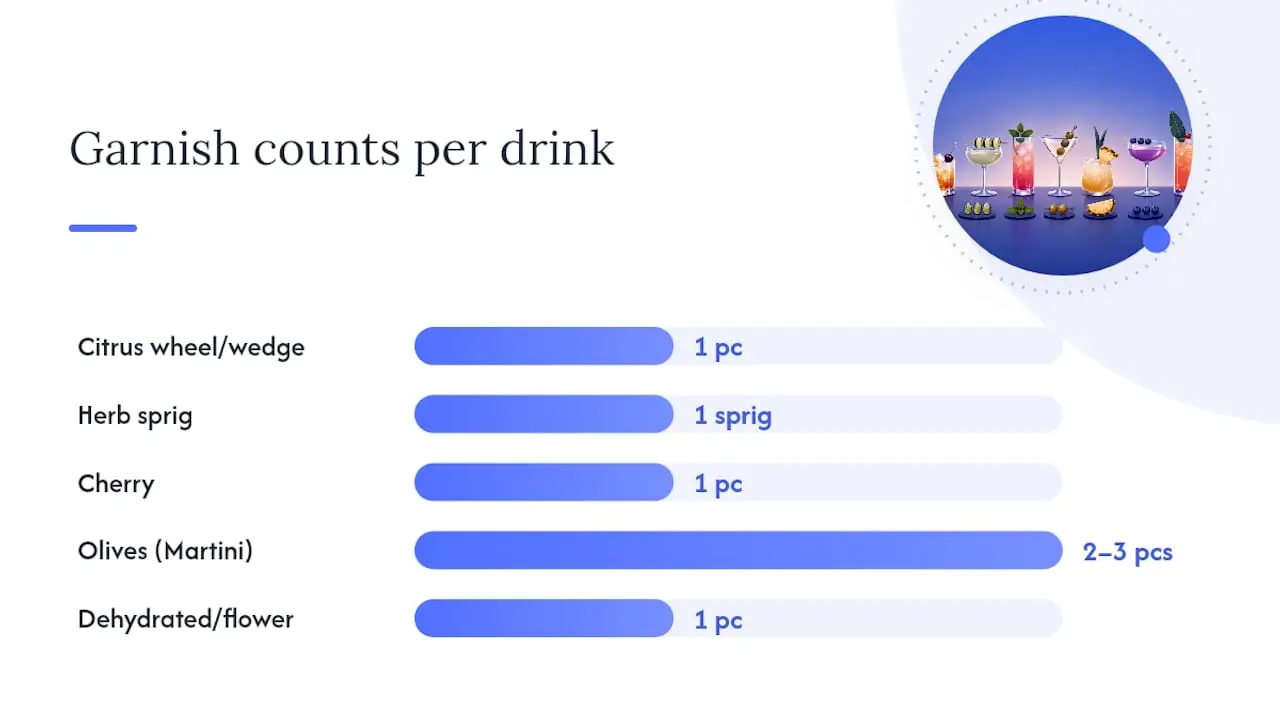
Dehydrated citrus wheels and edible flowers are single-piece garnishes; one per drink is standard, placed for maximum visual impact since these are almost entirely about presentation. A dehydrated orange wheel on an Old Fashioned or a small edible flower resting on the foam of a sour both do their job with just one piece.
Garnish cost per cocktail typically runs $0.04 to $0.20 depending on the item, which is worth keeping in mind before you start doubling counts out of habit.
A few classic examples make the counts concrete:
- Old Fashioned: one orange twist (expressed and dropped in) or one brandied cherry, not both unless the recipe specifically calls for a flag garnish.
- Margarita: one lime wheel or wedge, plus an optional salted rim; the classic 2:1:1 ratio doesn’t change the garnish math.
- Mojito: one muddled sprig plus one fresh sprig on top, occasionally with a lime wheel wedged on the rim.
- Martini: one twist or one to three olives, never both at full quantity.
How Do You Scale Garnish Quantities for Events?
Per-drink specs are easy. The math gets harder once you’re planning for 50 or 100 guests over a multi-hour event, and this is where most home hosts (and more than a few bartenders) get the shopping list wrong.
Start with per-guest, per-hour assumptions rather than per-drink ones, since guests typically order more than one cocktail across a service window. Planning references built for event bartenders, like Miss Vickie’s batch calculator, suggest roughly two citrus wedges and two mint sprigs per guest for a two-hour service, which you can scale linearly for longer events.
The formula looks like this:
- Estimate drinks per guest per hour. A common assumption is one to one and a half cocktails per guest per hour, adjusted for whether cocktails or beer and wine are also on offer.
- Multiply by garnish-per-drink. If 60% of your cocktails are citrus-garnished and 40% are herb-garnished, split your totals accordingly rather than assuming every drink needs every garnish type.
- Apply your yield assumptions. One lime yields roughly 8 to 10 usable wheels or wedges; one bunch of mint yields around 15 to 20 usable sprigs after trimming.
- Add a 15 to 20% waste buffer for bruising, over-trimming, and last-minute recipe changes.
Here’s how that plays out for a mid-sized event:
| Planning Variable | Sample Calculation (50 Guests, 3 Hours) |
|---|---|
| Estimated cocktails served | 150 (1 per guest per hour) |
| Citrus wedges needed | 100 wedges, roughly 10 to 12 limes |
| Mint sprigs needed | 100 sprigs, roughly 5 bunches |
| Cherries or olives needed | 75 to 150 pieces depending on recipe mix |
| Waste buffer applied | Add 15 to 20% to every line above |
Running this math by hand for a full event menu gets tedious fast, which is exactly the gap a batch cocktail planning guide is built to close, converting your guest count and service length directly into a shopping list instead of leaving you to eyeball it.
When Should You Prep, Store, and Rotate Garnishes?
Timing separates a garnish that tastes bright from one that tastes tired. The rule of thumb: prep delicate items as close to service as possible, and prep stable items whenever your schedule allows.
Fresh herb sprigs, muddled berries, and anything cut for texture (not just looks) should be prepped the same day, ideally within a few hours of service. Herbs oxidize and wilt fast once trimmed, and mint in particular loses its aromatic punch within hours of being cut. Dehydrated citrus wheels, jarred cherries, and brined olives are the opposite story. These can be prepped or purchased days to weeks ahead without meaningful quality loss, which is why professional technique guides treat them as separate prep categories rather than lumping all garnish under one timeline.
Storage matters as much as timing:
- Keep citrus wheels and wedges in a shallow ice bath or chilled, lightly covered container to prevent drying out at the cut edge.
- Store fresh herbs in a breathable container, stems down in a small amount of water, similar to how you’d hold cut flowers.
- Keep preserved items (cherries, olives, pickled garnishes) sealed and refrigerated once opened.
- Batch-juice citrus no more than 24 hours ahead for events, since fresh citrus oxidizes and loses brightness quickly once juiced.
Pro Tip: Label every prep container with the time it was cut, not just the date. A sprig that’s fine at hour two is noticeably flat by hour six, and a quick glance at a timestamp saves you from garnishing drinks with tired herbs during a long event.
What Does Garnish Actually Cost Per Drink?
Garnish is one of the cheapest line items on a cocktail menu, but it’s also one of the easiest to blow out with careless portioning. Knowing the cost bands helps you decide where a premium garnish is worth it and where it’s just margin erosion.
Fresh citrus sits at the low end, typically $0.04 to $0.08 per garnish once you account for yield. Herbs run higher per piece, around $0.10 to $0.20, since sprigs can’t be portioned as efficiently as citrus wedges. Specialty items (edible flowers, imported cherries, house-made dehydrated wheels) can run $0.30 to $0.50 or more per piece, which sounds trivial until you multiply it across a full event.
Here’s the costing math in practice:
- Start with wholesale price. A case of limes costing $18 for roughly 80 limes works out to $0.225 per lime.
- Divide by usable yield. At 8 to 10 wedges per lime, that’s roughly $0.02 to $0.03 per wedge before waste.
- Add your waste buffer. Applying a 15 to 20% loss rate brings the realistic cost closer to $0.03 to $0.04 per wedge.
- Compare against premium items. A specialty cherry at $0.40 each costs more than ten citrus wedges combined, which is exactly why it belongs on a premium cocktail, not a well drink.
Reserve expensive garnishes like edible flowers or specialty cherries for signature or premium-tier cocktails where the price point already supports the cost, and note them on the menu so guests understand the upgrade. For everyday and well drinks, fresh citrus and herbs do the job at a fraction of the cost, a distinction worth building into any cocktail menu design from the start.
What Are the Best Low-Waste Garnish Practices?
The guiding principle is simple: garnish only when it adds aroma, flavor, or texture, and skip anything purely decorative that a guest will just discard. That single filter cuts a surprising amount of waste before it happens.
Repurposing scraps is the next lever. Citrus peels left over from juicing can go into simple syrups or oleo saccharum instead of the trash, and trimmed herb stems can flavor batch syrups rather than being tossed. Sustainable garnish guidance points to exactly this kind of reuse as standard practice for a modern bar program, not an optional extra.
A few on-shift habits reduce waste further:
- Micro-portion citrus by cutting only what you expect to use in the next hour of service, not the whole shift at once.
- Prep in small batches with rotation, using older cuts first (first in, first out).
- Compost trimmings and peels where local rules allow it, instead of sending them to the trash.
- Buy in-season, local produce when possible. It’s usually fresher, cheaper, and lower in transport waste than off-season imports.
Choosing dehydrated or preserved garnishes strategically also cuts waste, since they hold quality far longer than fresh cuts and reduce the odds of tossing spoiled product.
How Does Cocktail Crew Apply This in Real Events?
These aren’t abstract rules for us. Cocktail Crew bartenders build garnish counts into every event plan, starting with the same per-drink logic covered above and scaling it against guest count and service length. Every booking runs on a flexible three-hour minimum, which gives hosts room to plan garnish and drink quantities without the rigid all-night packages other services push.
For a typical 75-guest, three-hour event, a sample prep list looks like this:
- Roughly 150 citrus wedges or wheels (about 15 to 18 limes and lemons combined)
- 12 to 15 bunches of fresh mint for muddled and garnish sprigs
- 100 to 150 cherries or olives, depending on the cocktail menu mix
- A 15 to 20% buffer built into every line for trimming and last-minute demand
The math only works if someone actually runs it before the event, not during it. Guests don’t notice a perfectly portioned garnish. They absolutely notice a bar that runs out of limes at hour two.
Our cocktail calculator takes exactly this kind of guest count and service length input and turns it into a real shopping list, built by bartenders who run this math for a living.
Selected External Guides, Calculators, and Internal Tools
A few resources are worth bookmarking alongside this guide. Miss Vickie’s batch cocktail calculator covers per-guest alcohol and garnish math in more depth, while the Napa Valley Wine Academy’s garnish guide is a solid reference for the echo, contrast, proportion framework. For plating ideas that translate well to glassware, Wild Foodz’s food presentation examples are worth a look. On the planning side, Cocktail Crew’s own batch cocktails guide and bartender staffing guide round out the event math covered here.
Why Exact Garnish Counts Beat “Garnish to Taste”
Most cocktail advice treats garnish as an afterthought, a flourish added once the real work of mixing is done. That’s backward. The research on aroma, flavor, and texture makes clear that garnish quantity is a recipe decision, not a plating one, and treating it that way changes how much you use.
The conventional wisdom, “garnish to taste” or “however it looks nice,” fails precisely because it has no unit of measurement. You can’t train a new bartender on a feeling, and you can’t build a shopping list around one either. Exact counts, one wheel, one sprig, three olives, are what let a five-person bar team pour a consistent drink and let a home host order the right number of limes without guessing.
If I had to pick one place to start, it’s the waste buffer. Bartenders nail the per-drink counts constantly and then get blindsided partway through an event because nobody padded the order. Get the math right upfront, and the actual garnishing becomes the easy part.
— Nelson
Sources
- How to garnish your cocktails with sustainability in mind
- Batch Cocktail Calculator: How Much Alcohol Per Person? – Miss Vickie
- The Ultimate Guide to Garnishing Cocktails and Other Drinks
- How to Garnish Your Cocktails Like a Pro