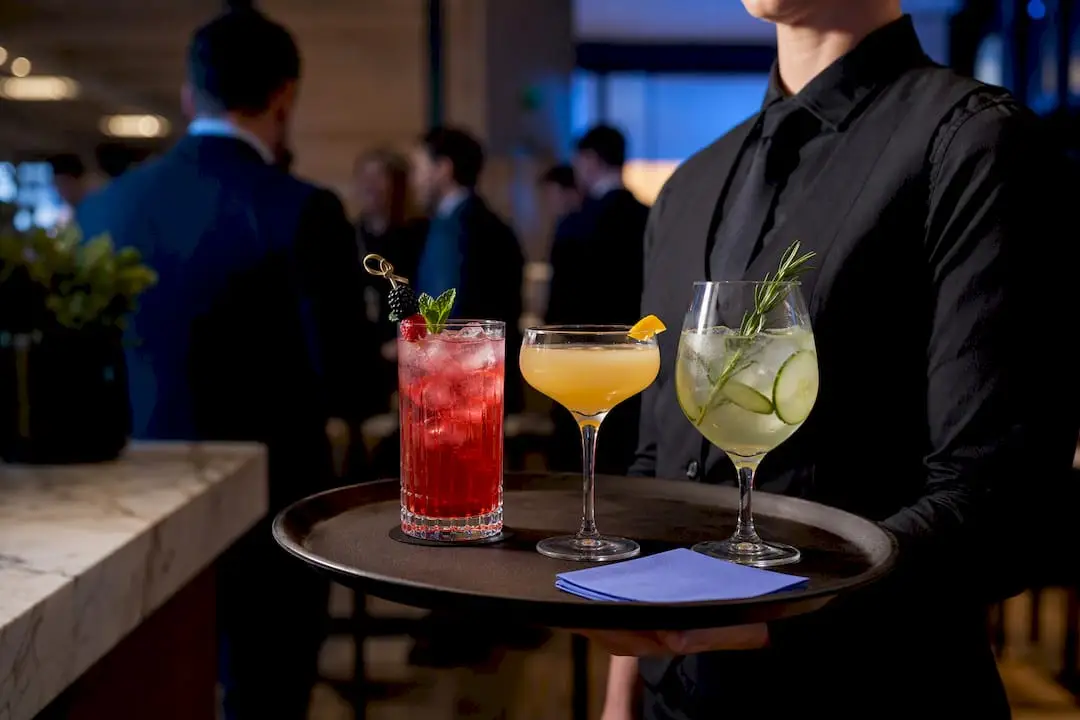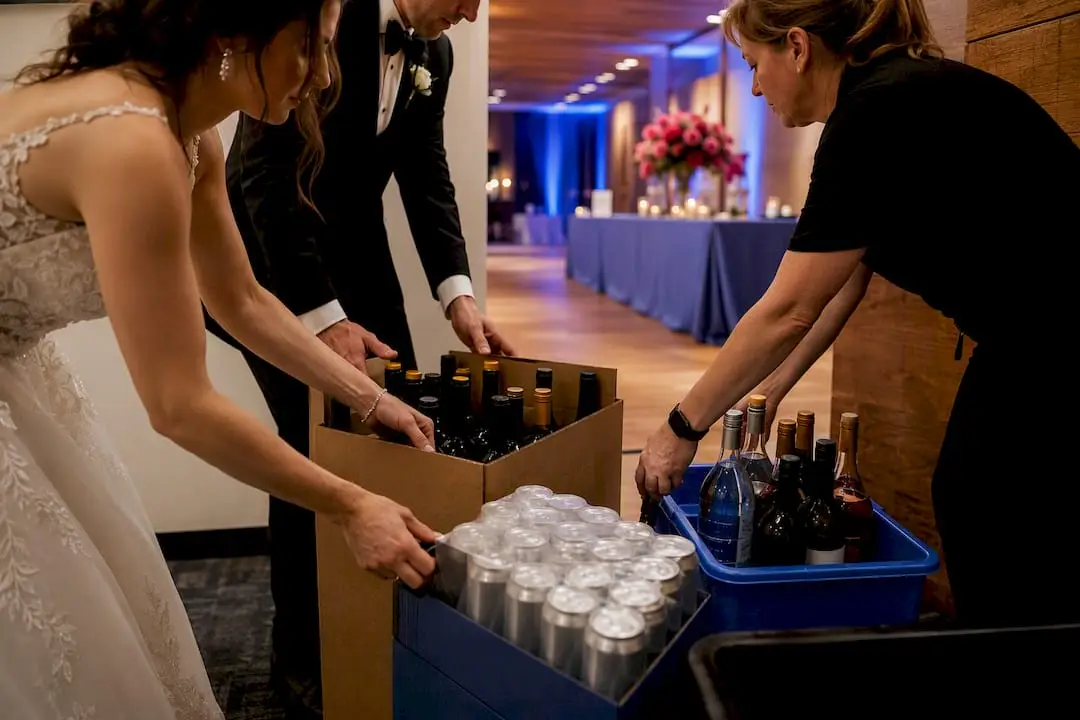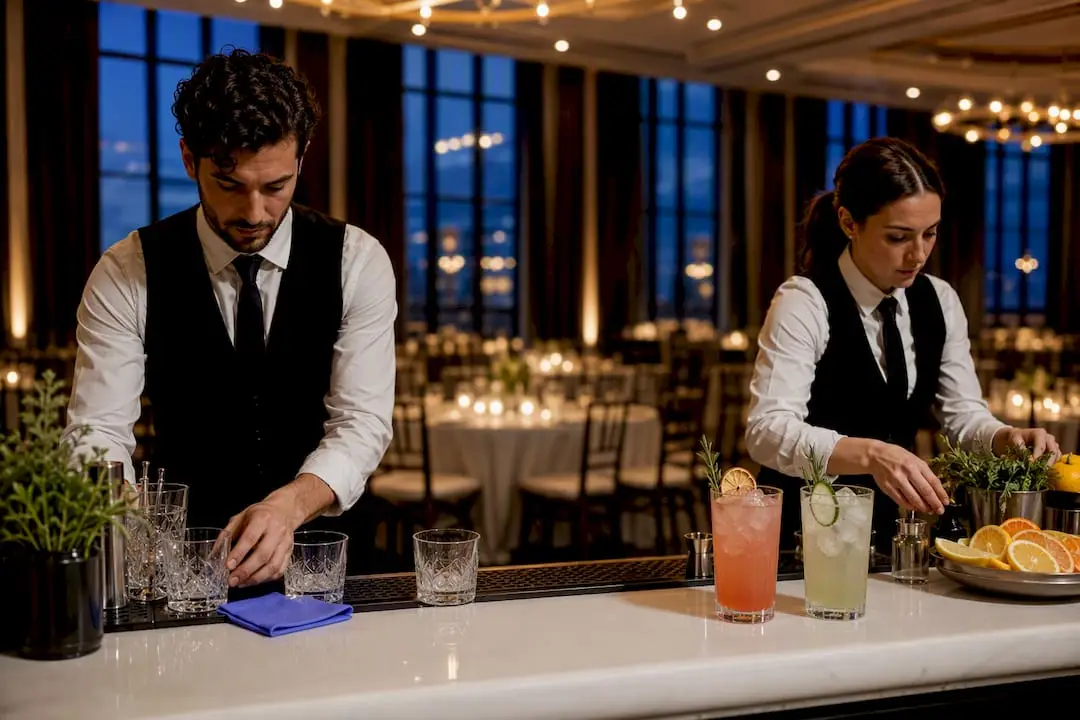
Hire a professional mocktail bartender to run your dry wedding bar. A skilled bartender builds a menu of elevated zero-proof drinks, keeps service moving during toasts and the reception rush, and gives every guest, sober or not, something worth photographing. Doing this yourself invites logistics headaches; a pro with tastings and a clear staffing plan, like The Cocktail Crew, removes that risk entirely.
TL;DR:
- A professional mocktail bartender expertly designs and serves non-alcoholic drinks with presentation flair, efficiency, and real operational know-how.
- A simple menu of two signature mocktails, one fizz option, and batch-friendly recipes can cover most guest preferences and streamline service.
- Staffing should follow guest counts of one bartender per 50-75 guests, with additional support for larger parties, plus a well-organized bar setup.
- Budget estimates range from $800 to $1,500 for 100 guests, with costs increasing based on premium ingredients, labor, and the number of guests.
- Valid vendor questions include experience with mocktails, staffing ratios, included equipment, and the ability to offer tastings before booking.
Table of Contents
- What does a dry wedding bartender actually do?
- How do you plan a mocktail menu that actually works?
- How many bartenders do you need, and how should the bar be set up?
- What should you budget for an elevated mocktail bar?
- What questions should you ask before booking a bartender?
- Does an alcohol-free reception run on a different timeline?
- What experience should a dry wedding bartender have?
- Where do you find and vet a qualified mocktail bartender?
- How do you coordinate the bartender with your other vendors?
- Why a professional team changes how a dry wedding feels
- Book a bartender who makes your dry wedding feel like the real thing
- Resources for planning your dry wedding bar
- Sources
What does a dry wedding bartender actually do?
A dry wedding bartender is a professional who builds and serves an entire non-alcoholic beverage program with the same skill, speed, and showmanship you’d expect from a full liquor bar. This is different from someone just pouring soda and juice behind a table. The role centers on menu design using nonalcoholic spirits, shrubs, house-made syrups, and bitters to create drinks with real depth and balance, not sugary punch.
Presentation matters just as much as flavor. A trained bartender knows how to garnish, layer, and flame or smoke a drink so it feels like an event, not a consolation prize for skipping the champagne toast. Behind the visible flair sits real operational work.
- Batch-prepping syrups and juices ahead of the reception so the line never backs up
- Staging garnishes, ice, and glassware for fast service during peak rushes
- Reading the room, chatting with guests, and keeping the bar feeling social rather than transactional
- Managing waste by prepping to guest count instead of overbuying ingredients
A bartender who specializes in this format keeps your timeline intact. Someone winging it from a Pinterest board usually doesn’t.
How do you plan a mocktail menu that actually works?
Start small. Two signature mocktails that match your wedding’s personality, plus one or two complementary options, cover most guest preferences without overloading your bartender’s prep list. This approach simplifies staffing and procurement while still giving guests variety and something photogenic to hold during the first dance.
- Pick your two anchors. One bright and citrus-forward, one darker and spirit-forward using a nonalcoholic spirit, so the menu has range.
- Add a fizz option. A sparkling shrub or tonic-based drink gives guests something lighter for warm-weather receptions.
- Stock the essentials. Fresh citrus, quality syrups, sparkling water or tonic, shrubs, bitters, fresh herbs, and one or two nonalcoholic spirits cover almost any recipe.
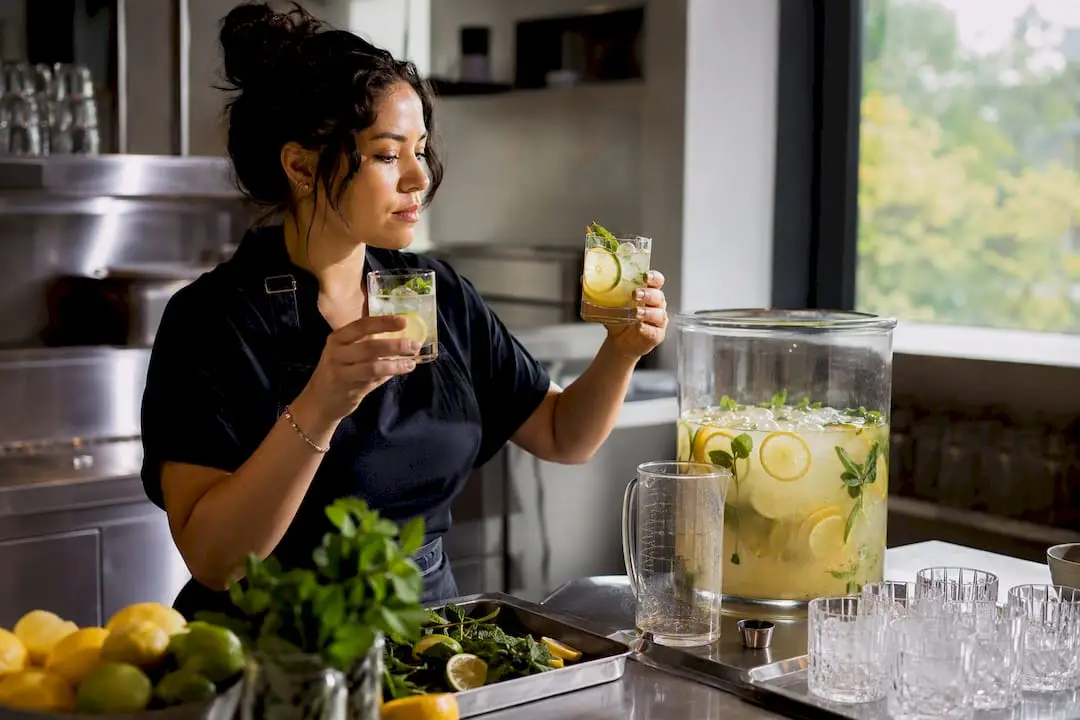
- Write batch-friendly recipes. Recipes that scale in batches of ten or twenty pour faster than anything measured drink by drink.
- Hand off a prep sheet. Give your bartender a sheet listing batch yields, glassware, and garnish instructions so service stays consistent even during the busiest twenty minutes of the night.
Budget roughly $3 to $8 per guest for non-alcoholic beverages before any upgrades, and add another 15 to 20% if you’re leaning into premium ingredients or a more elaborate build, according to Tiny Luxe Weddings.
Pro Tip: Test your two signature mocktails at a tasting before you finalize the menu. A recipe that tastes great in a home kitchen sometimes falls apart when it’s batched for 150 people and served over ice for four hours straight.
How many bartenders do you need, and how should the bar be set up?
Guest count drives staffing, and most planners lean on one bartender per 50 to 75 guests for a mocktail-only bar, adding a runner or barback once you cross 150 guests to keep garnishes and ice replenished without pulling the bartender off the line.
Most professional bartending services, including The Cocktail Crew, work on a three-hour minimum, which usually covers cocktail hour through the start of dinner. You’ll want service mapped against your key moments:
- Cocktail hour: full staffing, welcome drink ready to hand off fast
- Dinner and toasts: lighter staffing, since most guests are seated
- Dancing through send-off: back to full staffing as the bar becomes the social hub again
For layout, a U-shaped or open-face bar setup lets one or two bartenders serve from multiple angles without guests forming a single long line. Stage garnishes, ice wells, and glassware within arm’s reach so a bartender never has to step away mid-order. Dry receptions often run a tighter, more structured timeline than boozy ones, since there’s no lingering open bar to slow the room down, so staging matters even more.
What should you budget for an elevated mocktail bar?
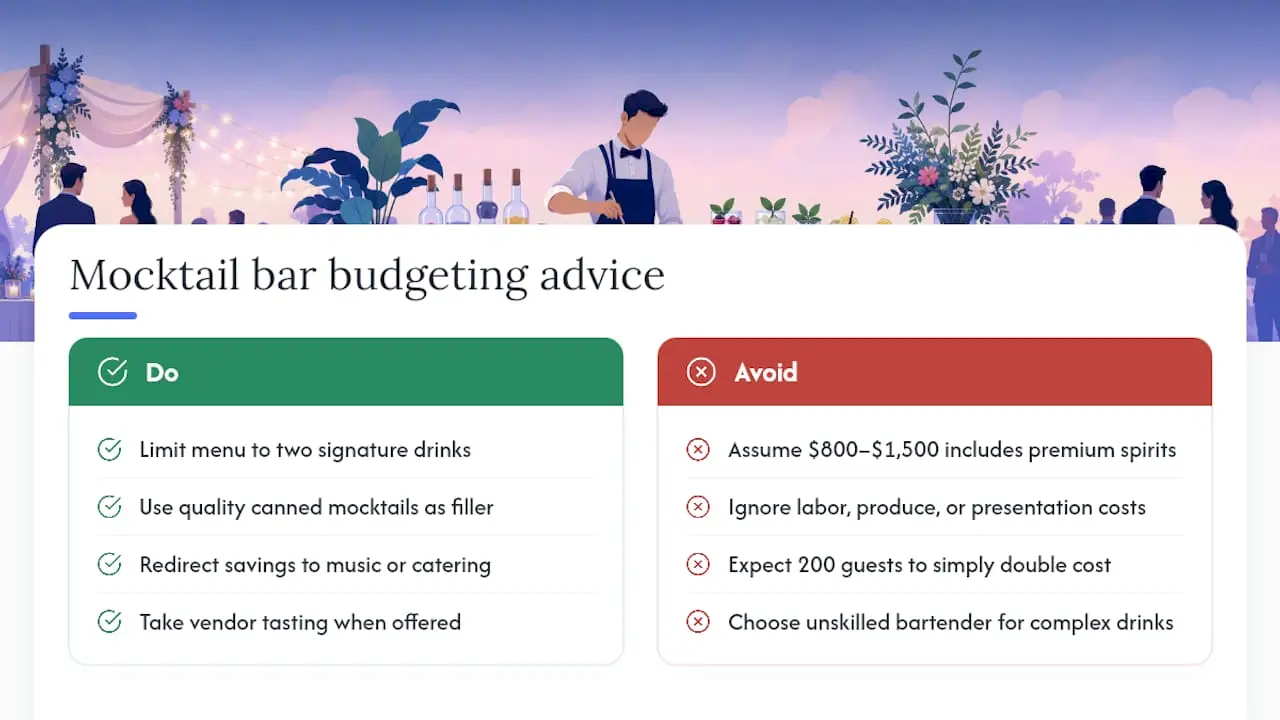
A mocktail bar with a bartender runs roughly $800 to $1,500 for 100 guests in a typical dry wedding budget, according to Wedding Notepad. That figure covers labor and standard ingredients, not necessarily premium nonalcoholic spirits or elaborate garnish work.
Labor, produce, and presentation are the three levers that move this number. Fresh citrus and herbs cost more than syrup concentrates, premium nonalcoholic spirits carry a real price tag, and a bartender skilled enough to layer and flame a drink usually charges more than someone just pouring from a pitcher. Guest count multiplies all of it, so a 200-guest wedding doesn’t just double the 100-guest budget. It often needs a second bartender, which changes the labor math entirely.
Some event professionals note that a genuinely high-end mocktail bar, built on premium ingredients and skilled labor, can approach the cost of a traditional open bar per guest. If your budget is tight, limit your menu to two signature drinks, use quality canned mocktails as a filler option rather than the centerpiece, and redirect savings toward music or catering instead. When a vendor quotes you a fair number for a tasting, take it. That tasting is often what separates a forgettable drink from one guests talk about.
What questions should you ask before booking a bartender?
Vet every candidate the same way you’d vet a caterer, with direct questions and a written contract, not a handshake and hope.
- Do you specialize in mocktails, and can you share sample menus from past dry weddings?
- What’s your staffing ratio, and does that ratio include a runner or barback for larger guest counts?
- What equipment is included, versus what you’re expected to rent or supply yourself?
- Can you accommodate a tasting, and is there a fee attached to it?
- Are you insured, and what’s your minimum booking window?
These are the exact categories The Knot recommends confirming with any wedding bartender, mocktail-focused or not. On the contract side, nail down setup and breakdown times, who supplies ingredients, cancellation and refund terms, and who handles cleanup. Red flags include vendors who can’t name a single nonalcoholic spirit brand they’ve worked with, or who dodge questions about staffing ratios.
Does an alcohol-free reception run on a different timeline?
Yes, and it changes how you brief your bartender. Without an open bar acting as a slow-moving social anchor, guests tend to move through cocktail hour faster and gravitate toward food, seating, and the dance floor sooner. That means your bartender needs the signature mocktails ready to pour the moment doors open, not fifteen minutes into the hour.
Presentation carries more weight here too. A skilled mocktail bartender can build zero-proof versions of classic cocktails that photograph and taste like the real thing, which matters enormously when there’s no champagne flute doing the visual heavy lifting during toasts. Ask your bartender to plan a specific drink for the toast moment itself, something that pours quickly for a large group and looks intentional in photos, rather than defaulting to sparkling cider.
Guest experience also shifts because the bar becomes more of a conversation hub than a waiting line. Guests who aren’t drinking often linger at the bar longer, chatting with the bartender, which means your hire needs genuine hospitality skills, not just recipe knowledge. Build in a slightly longer cocktail hour if your venue allows it. It gives your bartender room to actually engage guests instead of just processing orders back to back.
What experience should a dry wedding bartender have?
Look for a bartender who treats mocktails as a specialty, not an afterthought tacked onto a standard cocktail menu. There’s a real skill gap between someone who can build a solid Old Fashioned and someone who can rebuild that same balance of sweet, bitter, and acid without the alcohol doing half the work.
Ask candidates directly about their experience with nonalcoholic spirits, shrubs, and bitters, and ask to see photos or a tasting of past work. A bartender worth hiring will talk about creativity and presentation unprompted, not just recite a list of ingredients. Formal bartending certifications exist, but for this specific niche, a portfolio of past dry weddings or events matters more than a certificate on a wall.
Event fit matters too. A bartender who’s worked casual backyard parties might not have the polish for a black-tie reception, and vice versa. Ask how they’d adjust their approach based on your event’s formality, and listen for specifics rather than generic reassurance. The right hire treats a dry wedding bar as its own craft, not a scaled-down version of a real bar.
Where do you find and vet a qualified mocktail bartender?
Start with referrals from your venue or caterer, since they’ve already seen vendors perform under real event conditions. Wedding planning platforms and directories are useful for casting a wide net, but reviews only tell part of the story. Look specifically for mentions of mocktails or non-alcoholic service in the reviews themselves, not just general praise about the bar.
Once you have a shortlist, request sample menus and, if possible, a tasting. A tasting reveals more than any portfolio photo, since you can judge balance, presentation, and how the bartender talks about their craft in person. Cross-check reviews across multiple platforms rather than trusting a single glowing testimonial, and ask the vendor directly for references from past dry weddings if their portfolio is thin on non-alcoholic work.
Providers who specialize in private event bartending, rather than treating mocktails as a side offering, tend to have tighter systems already in place: standard staffing ratios, prep sheets, and clear minimums. That specialization is often the fastest signal that a vendor will deliver a smooth night rather than an improvised one.
How do you coordinate the bartender with your other vendors?
Loop your bartender into the same planning thread as your caterer and day-of coordinator, not a separate conversation happening in isolation. Timing conflicts are the most common failure point: if dinner service and cocktail hour overlap awkwardly, or the cake cutting gets moved up without warning, your bar staff needs to know before the day arrives.
Share your full reception timeline with the bartender at least two weeks out, including exact moments for toasts, first dance, and send-off, so they can plan prep and staffing around those beats rather than reacting in real time. Confirm with your caterer whether the bar and food stations will compete for the same prep space or ice supply, since that’s an easy oversight that slows both down.
Your coordinator should also know the bar’s setup and breakdown window, so it doesn’t conflict with room flips or vendor load-out. If you’re using a rental company for glassware or a specialty ice sculpture, confirm delivery timing directly with your bartender rather than assuming your planner has it covered. The vendors who communicate directly with each other, instead of routing everything through you, are usually the ones who deliver the smoothest night.
Why a professional team changes how a dry wedding feels
Nelson has spent years writing about professional bartending for private events, and the pattern holds across every dry wedding worth talking about afterward: the drinks looked intentional, not like a substitute. The Cocktail Crew builds that intention into its three-hour minimums, tastings, and a cocktail calculator that takes the guesswork out of quantities.
One recent private event had a bartender rebuild a smoked Old Fashioned entirely zero-proof for a couple’s toast. Guests who’d never touched a mocktail before asked for the recipe. That’s the real measure of a dry bar done right: nobody feels like they’re missing something.
— Nelson
Book a bartender who makes your dry wedding feel like the real thing
The Cocktail Crew gives you what a DIY mocktail bar can’t: bartenders who specialize in nonalcoholic craft drinks, a three-hour minimum that fits most reception timelines, and a cocktail calculator that turns your guest count into an exact shopping list before you ever call a vendor.
Tastings are available so you can taste your signature mocktails before you commit to a final menu, and staffing is built around your actual timeline, not a generic template. Reviews consistently point to the same thing: guests remember the drinks, not the absence of alcohol. If you’re ready to move forward, request a quote through The Cocktail Crew’s private event bartending page and get a staffing plan built around your guest count and venue layout.
Resources for planning your dry wedding bar
For deeper budgeting detail, see what couples actually pay for a wedding bar. For menu structure and layout ideas, check mocktail bar styling inspiration and ingredient sourcing tips from Wild Foodz for fresh produce and garnish ideas.
Sources
- Dry Wedding Guide – How to Host an Alcohol-Free Wedding Guests Love | Wedding Notepad
- How to Create a Non-Alcoholic Wedding Bar – Tiny Luxe Weddings
- How to Hire the Perfect Mocktail Bartender for Your Next Event – Topic Territory
- Questions to ask your wedding bartender | The Knot