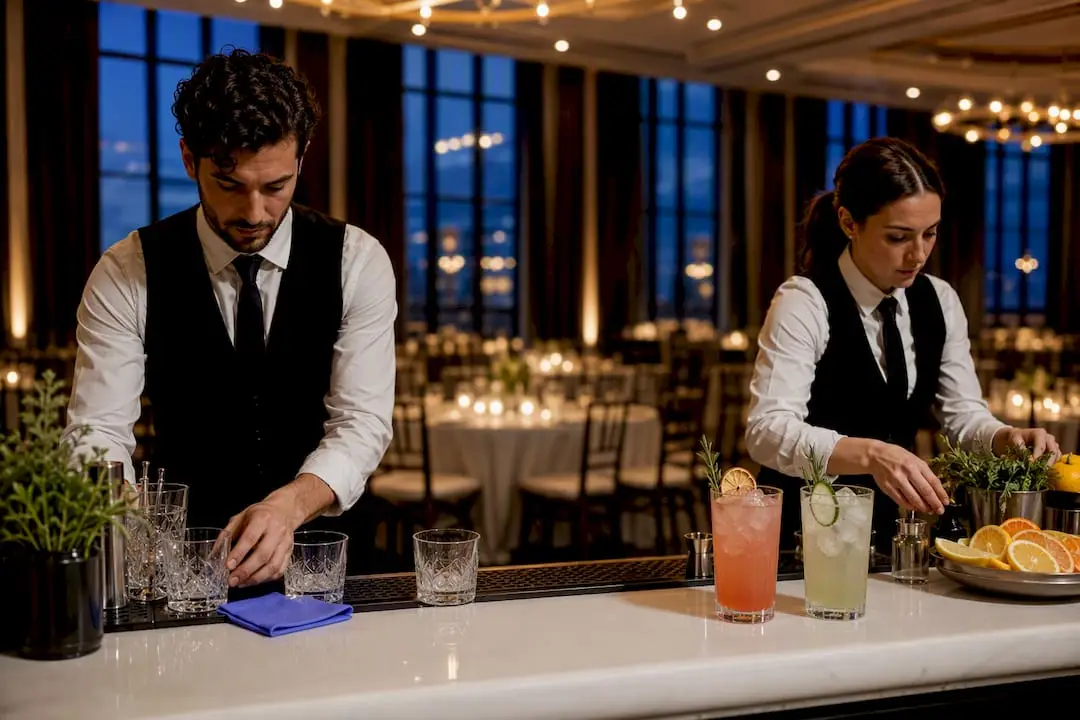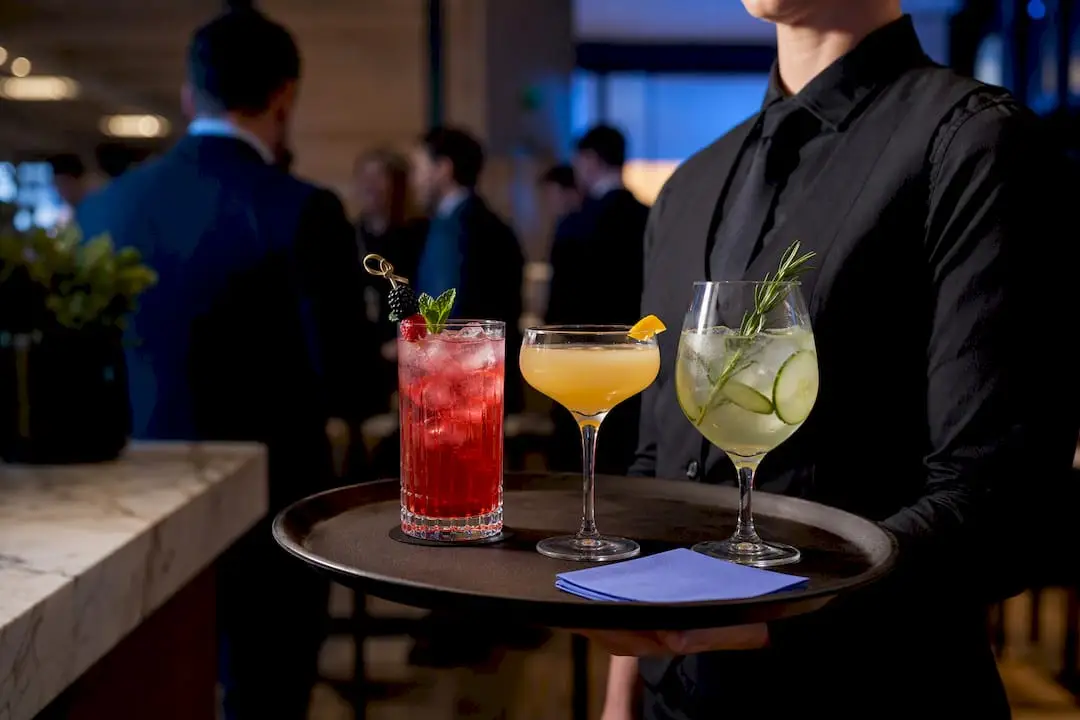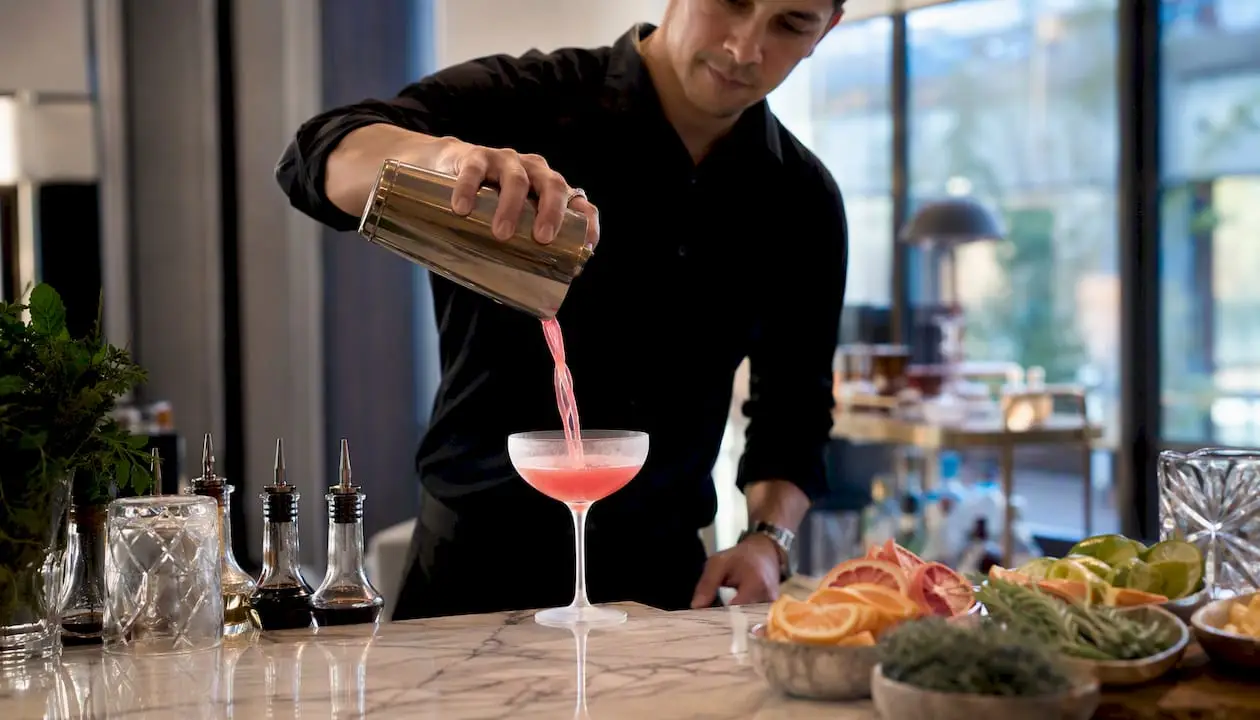
A mobile bartending setup is a portable bar station combining a folding or modular bar unit, ice management, a speed rail, and the tools or staff to run service anywhere. For most hosts, the fastest reliable route is a folding pro bar that collapses to 8″ for transport, a standard 30″ ice chest, and a fold-in speed rail. If you’d rather skip the gear entirely, a staffed service like The Cocktail Crew handles everything from the bar itself to the cocktails.
Three quickest options by use case:
- Backyard DIY: A lightweight folding bar table (GoBar, VEVOR, or VINGLI) plus an insulated ice chest and basic tool kit. Setup runs 5–10 minutes solo.
- Corporate or trade-show: A pro folding bar like the PortableBar Signature 62 or a Perlick modular unit with integrated drainage and LED lighting. Two-person deploy: several minutes to under an hour depending on configuration.
- Full-service, zero logistics: Book The Cocktail Crew. They arrive with the bar, the bartenders, and the plan.
Table of Contents
- What does a mobile bartending station actually need?
- How do you set up a mobile bar station fast?
- Which portable bar type fits your event?
- What models and vendors are worth buying in the U.S.?
- What health, power, and permit basics should you confirm first?
- How much does a mobile bar setup cost, and how long does it take?
- How do pro bartenders keep service fast and avoid burnout?
- What should you pack for every mobile bartending gig?
- Which setup is right for your event?
- Key Takeaways
- What pro bartenders actually do before doors open
- When hiring a pro beats buying the gear
- Useful sources and where to learn more
What does a mobile bartending station actually need?
Every functional station shares the same core anatomy, whether it’s a $150 folding table or a $5,000 Perlick pod.
- Portable bar or table: Folding pop-up tables, lightweight folding bars, signature-style 62″ pro bars, or heavy modular trade-show pods. Material matters: aluminum frames outlast plastic in outdoor conditions; wood-laminate tops look sharp but add weight.
- Ice management: A 30″ ice chest with a sliding cover is the pro standard. Drainage matters too — ice melt pooling under a bar creates a slip hazard and a sanitation problem.
- Speed rail and bottle well: A fold-in speed rail keeps your most-used bottles within arm’s reach. Insulated bottle wells slow ice melt; powered refrigeration units are better for long events but need a 120V outlet.
- Sanitation station: A portable hand sink or sanitizer station is required at most permitted events. Grey-water capacity varies by unit; know your venue’s disposal rules before you arrive.
- Power and lighting: LED task lighting runs off battery packs or a standard outlet. Blenders and refrigerated units typically need 120V AC at 60Hz. Some bars ship with removable battery packs and a plug-in adapter so you can run off-grid for limited periods.
- Storage and transport protection: Locking casters, protective covers, and a carry case that fits the bar’s folded dimensions keep gear intact between events. Fold-to-8″ units fit through standard doorways and into most SUV cargo areas without a rental truck.
How do you set up a mobile bar station fast?
A disciplined sequence gets you from van to service in under an hour, even for a full pro rig. Here’s the order that works.
- Site sweep (2 minutes): Walk the space. Confirm power outlet locations, floor surface, guest traffic flow, and sightlines. Flag anything that needs floor protection or a cord cover.
- Unload and position (3–5 minutes): Wheel the bar into its final spot before unfolding. Repositioning a fully loaded bar wastes time and risks spills.
- Level and lock casters (1 minute): Engage all locking casters before placing anything on the surface. On uneven outdoor ground, use leveling feet if your unit has them.
- Unfold the bar and attach speed rail (2–3 minutes): Fold-in speed rails that stay attached to the frame during transport skip this step entirely, saving setup minutes and eliminating the risk of leaving hardware in the van.
- Set ice bins and fill (3–5 minutes): Fill the ice chest and bottle wells. Slide the cover closed until service opens to slow melt.
- Mis-en-place sequence (10–20 minutes): This is where most of your time goes, and it’s worth every minute. Pre-shift prep — batching syrups, polishing glassware, cutting garnishes, staging tools — is the single biggest determinant of how smoothly peak service runs.
- POS and payment setup (2–3 minutes): Square or a similar mobile reader needs a charged device and a tested connection before guests arrive.
- Final verification (2 minutes): Confirm sanitation station is stocked, ice level is full, waste bins are in place, and all staff know their positions.
Timing benchmarks: Solo deploy with a small folding bar takes several minutes. Two-person deploy with a Signature 62-style pro bar takes around ten minutes. Full modular bank (Perlick or equivalent) can take up to under an hour.
Which portable bar type fits your event?
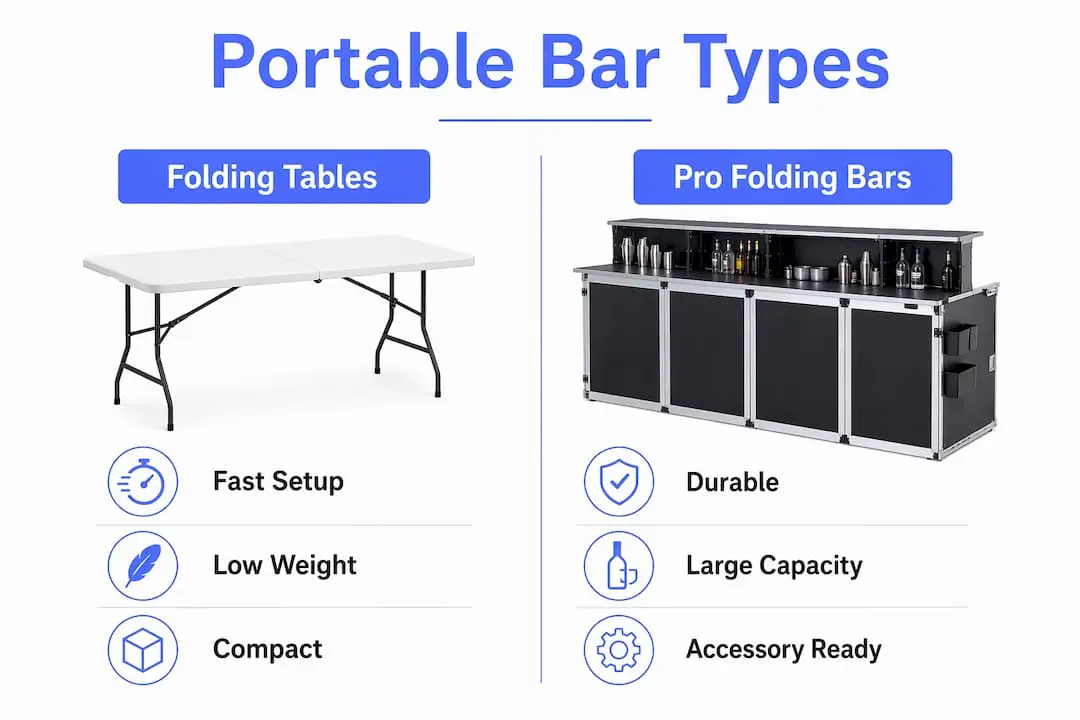
The bar type you choose shapes everything: how long setup takes, whether you need a truck, and how the station looks when guests walk in. Four categories cover most events.
Folding pop-up tables (GoBar, VEVOR, VINGLI, Giantex, REDCAMP, COSTWAY, Trademark Innovations, Goplus, Best Choice Products, Portable Lightweight Bartenders & Caterers Table) are the entry point. They’re light, cheap, and fast. The trade-off is minimal storage, no integrated sanitation, and a look that reads “backyard” rather than “event.”
Lightweight folding pro bars (PortableBar Mobile Mini, VINGLI 45″, PartyLife 48″ with LED, Flash Furniture 4’, Vercraft riser tables) add a finished aesthetic, sometimes LED lighting, and a carrying case. The Mobile Mini folds to 8″ and weighs 55 lbs, making it genuinely one-person portable.
Signature-style 62″ pro bars (PortableBar Signature 62, GoBar PRO, GoPong GoBar Elite, VINGLI 78″, Giantex 81″) give two bartenders enough workspace to run a busy service. The Signature 62 weighs about 100 lbs, folds to 8″, and assembles in roughly 60 seconds. That fold depth is deliberate: it fits through standard doorways and into SUV cargo areas without a rental truck.
Modular trade-show pods (Perlick MOBS series) are a different category entirely. The Perlick Signature Mobile Bars feature 42″ and 66″ top configurations, integrated ice-melt drainage tanks, dimmable LED task lighting, and locking 5″ stainless steel casters. They’re engineered for high-volume hotel and catering use, not backyard parties.
Pro Tip: Look for speed rails that fold into the bar frame rather than detach. Fold-away rails mean one less thing to remove, pack, and potentially lose between events, and they shave real minutes off your setup.
| Bar type | Setup time | Folded size / weight | Material | Storage capacity | Accessories | Price range | Best use case |
|---|---|---|---|---|---|---|---|
| Folding pop-up table (GoBar, VEVOR, VINGLI, etc.) | several minutes | Varies / 20 lbs | Plastic / aluminum | Minimal | Carrying bag | $50–$100 | Backyard, casual party |
| Lightweight folding pro bar (Mobile Mini, PartyLife, Flash Furniture) | several minutes | 8″ fold / 55 lbs | Aluminum / laminate | 1–2 shelves | Carry case, some LED | $150–$300 | Small events, single bartender |
| Signature 62″ pro bar (PortableBar Sig 62, GoBar PRO, VINGLI 78″, Giantex 81″) | 60 sec–12 min | 8″ fold / ~100 lbs | Aluminum / laminate | Speed rail, shelves | Skirt, LED, carry case | $400–$600 | Weddings, corporate, two-bartender service |
| Modular pod (Perlick MOBS) | under an hour | Crated / 100+ lbs | Stainless steel | Integrated drainage, ice chest | LED, sink module, casters | $1,500+ | Hotels, trade shows, high-volume catering |
| Staffed service (The Cocktail Crew) | 0 min for host | N/A | N/A | Included | Full kit + staff | Hourly / event rate | Any event, zero host logistics |
What models and vendors are worth buying in the U.S.?
Here’s a shortlist organized by tier, with sourcing notes.
Pro service: The Cocktail Crew is the turnkey option for hosts who want professional bartenders, a bar, and a plan without managing any of it themselves. Three-hour minimums give smaller events real flexibility. For wedding bartending, the staffed model removes a significant logistical burden from the couple.
Pro modular hardware: Perlick MOBS units are the benchmark for hotel and catering companies running high-volume events. Expect crating and freight costs on top of unit price; lead times for custom configurations can run several weeks.
Pro folding bars: PortableBar’s Signature 62 and Mobile Mini are the most specified folding bars in U.S. event rental inventories. Both fold to 8″, both assemble in under 60 seconds, and both ship with removable battery packs for off-grid LED use. Custom branding and graphic panels are available but add lead time.
Consumer and mid-tier folding bars: GoBar Portable Double Bar Table Set, GoBar PRO Commercial Grade Portable Bar Table, GoPong GoBar Elite Heavy-Duty Portable Bar Table, VINGLI Portable Bar Table, VINGLI 78″ Portable Bar Table, VINGLI 45″ Commercial Grade Portable Bar Table, PartyLife 48″ Premium Portable Bar Table w/LED Lights, VEVOR Folding Portable Bar Table, Flash Furniture 4’ Folding Portable Event Bar, Giantex 81″ Extra Long Portable Bar Table, REDCAMP Folding Portable Bar Table, COSTWAY Portable Bar Table for Events, Trademark Innovations Portable Bar Table, Vercraft Portable Bar Top Riser Tables, Goplus Folding Camping Table, Best Choice Products Portable Pop-Up Bar Table, and the Portable Lightweight Bartenders & Caterers Table are all available on Amazon or directly from vendor sites. Prices range from around $50 for basic folding tables to $600+ for heavier pro-style units with LED and carrying cases.
Buyer checklist before purchasing: Confirm the folded depth fits your vehicle and venue doorways (8″ or less is the target). Check warranty terms and whether replacement panels or parts are sold separately. Factor in shipping or crating costs for heavier units.
What health, power, and permit basics should you confirm first?
Getting these wrong can shut down a gig before the first drink is poured.
- Sanitation: Many venues and local health departments require a pre-plumbed hand sink for any food or beverage service. A portable sink with a grey-water tank handles this where plumbing isn’t available. Confirm grey-water disposal options with the venue before arrival.
- Ice-melt drainage: Pro units like Perlick bars include dedicated drainage tanks. Consumer folding bars don’t. Plan for a drip tray or absorbent mat under any bar without integrated drainage.
- Power: Perlick units and most refrigerated bars run on 120V AC at 60Hz, with some models drawing up to 13.3 amps. A dedicated 15-amp circuit is the safe minimum for refrigerated service. LED-only setups can run on battery packs. Use 12-gauge extension cords for runs over 25 feet; never daisy-chain power strips.
- Venue logistics: Confirm loading zone access, elevator dimensions for upper-floor events, and whether the venue requires floor protection under casters. Rooftop events often have ventilation restrictions for gas-powered equipment.
- Permits and licensing: Temporary event alcohol permits, health-department requirements for portable sinks, and venue insurance certificates vary by state and county. Build a permit verification step into your pre-event run sheet. Check your local health department and ABC board for current rules before any public or semi-public event.
This article is general information, not legal or regulatory advice. Confirm current permit and licensing requirements with your local health department, ABC board, or a qualified professional for your specific event.
How much does a mobile bar setup cost, and how long does it take?
Realistic numbers help you decide whether to buy, rent, or hire.
| Category | Typical setup time | Equipment price range | Notes |
|---|---|---|---|
| Consumer folding bar (GoBar, VEVOR, VINGLI, etc.) | 5–10 min | $50–$200 | Best for infrequent use; limited storage |
| Pro folding bar (PortableBar Sig 62, GoBar PRO) | 60 sec–12 min | $400–$600 | Good for frequent event pros; fold-to-8″ transport |
| Modular pod (Perlick MOBS) | under an hour | $1,500+ | For high-volume pros; freight and crating extra |
| Staffed service (The Cocktail Crew) | 0 min for host | Hourly / event rate | Three-hour minimum; full kit and staff included |
Staffing rates for bartenders vary by market, but most professional event bartenders in U.S. metro areas charge between $35 and $75 per hour, with a three-hour minimum being the standard floor for private events. For guest counts over 75, plan for two bartenders. The BLS Occupational Outlook Handbook notes that bartenders typically work under pressure to serve quickly during busy hours, which is exactly why staffing ratios matter at events.
Buy vs. rent: If you’re running more than four or five events per year, buying a pro folding bar pays off quickly against rental fees. For a one-time event, renting a bar and hiring staff through a service like The Cocktail Crew is almost always cheaper once you factor in transport, setup labor, and cleaning time. For a deeper look at the DIY vs. hiring tradeoffs, the math shifts depending on event frequency and complexity.
Always add transport time, setup labor (30–60 minutes for a full pro rig), and post-event breakdown and cleaning (another 30–45 minutes) into your event schedule. Hosts who budget only for service hours routinely run late.
How do pro bartenders keep service fast and avoid burnout?
The biggest throughput gains at a mobile bar come from layout and prep, not speed.
The zero-step bartender cockpit concept, central to Perlick’s Signature Mobile Bar design by Tobin Ellis, minimizes the steps and pivot distance a bartender takes per drink. Every tool, bottle, and garnish sits within arm’s reach. In a high-volume event context, that layout difference compounds across hundreds of drinks per shift.
Mise-en-place before service is non-negotiable. Batch your syrups the night before. Pre-cut citrus and portion garnishes into labeled trays. Polish glassware during setup, not during service. A bartender who reaches for a pre-cut lime wedge instead of cutting one mid-rush serves the next guest in seconds rather than 30.
Ergonomics matter more than most hosts realize. Counter height should sit at elbow level to avoid shoulder strain over a long shift. Non-slip, supportive footwear is standard practice among experienced mobile bartenders. Plan a 5-minute break every 90 minutes for any bartender working a full event. Burnout from skipping breaks shows up in slower pours and more spillage, not just fatigue.
Pro Tip: When blending tropical cocktails or batching frozen drinks, pre-measure and bag your ingredients before service. It cuts blender time per drink by more than half and keeps the station clean.
What should you pack for every mobile bartending gig?
A complete kit prevents the mid-event scramble. Run through this before every load-out.
Hardware:
- Spare multi-tool, duct tape, and zip ties for on-site fixes
- Extra locking casters and a wrench
- Extension cords (12-gauge for runs over 25 feet) and a power strip
- Leveling feet or rubber wedges for uneven surfaces
Bar supplies:
- Speed rails, jiggers, shakers, strainers, and pour spouts
- Bottle openers, wine keys, cutting boards, and channel knives
- Labeled garnish trays and a dedicated trash bin per station
Sanitation and ice:
- Extra ice bags (plan for more than you think you need)
- Hand sanitizer, disposable gloves, and sanitizer solution for tools
- Portable hand-sink parts and a grey-water container
- Spill mats under the bar and drip trays under taps
Operations:
- POS device with a charged backup battery
- Cash float and receipt paper
- Pre-batched mixes in labeled, sealed containers
- Backup glassware or disposable alternatives
Transport:
- Protective covers sized to your bar’s folded dimensions (8″ fold units fit most SUV cargo areas)
- Cargo straps and corner guards for stacked gear
- A checklist taped inside the transport case so nothing gets left behind
For premium glassware or branded barware at corporate activations, sourcing from a dedicated barware supplier keeps the presentation consistent without improvising on-site.
Which setup is right for your event?
The answer comes down to frequency, budget, and how much you want to manage.
- Backyard parties and infrequent hosts: A lightweight folding bar (VEVOR, GoBar, VINGLI) with an insulated ice chest is enough. For higher-stakes events where presentation matters, rent a pro bar or hire a staffed service.
- Event professionals and trade shows: Invest in a Signature 62-style folding pro bar or a Perlick modular unit. The durability, integrated sanitation, and professional finish justify the cost over multiple events. Check the mobile bar vs. traditional bartender breakdown if you’re still deciding on format.
- Hosts who want zero logistics: The Cocktail Crew handles the bar, the staff, the setup, and the service. Their three-hour minimum makes the model work for smaller gatherings, not just large weddings. For anyone who has ever spent the first hour of their own party wrestling with a folding bar and a bag of ice, that’s a real argument for hiring professionals.
Key Takeaways
A complete mobile bartending setup requires a folding or modular bar, a 30″ ice chest, a speed rail, sanitation provisions, and either trained staff or a full-service booking.
| Point | Details |
|---|---|
| Fold-to-8″ is the transport standard | Pro bars that fold to 8″ fit standard doorways and SUV cargo areas without a rental truck. |
| Mise-en-place drives throughput | Pre-batching, pre-cut garnishes, and polished glassware before doors open determines service speed more than anything else. |
| Verify power and permits early | Confirm 120V outlet availability, grey-water disposal, and local temporary alcohol permit requirements before event day. |
| Buy vs. rent threshold | Purchasing a pro folding bar makes financial sense at roughly four or more events per year; rent or hire for one-time events. |
| The Cocktail Crew for zero-logistics events | The Cocktail Crew’s three-hour minimum and full-service model covers bar, staff, and setup for hosts who prefer not to manage equipment. |
What pro bartenders actually do before doors open
The part of mobile bartending most hosts never see is the 45–60 minutes before a single guest arrives. That window is where the event is won or lost.
A realistic timeline for a three-hour booking looks like this: arrive 60 minutes before service, complete physical setup in 10–15 minutes, then spend the remaining time entirely on prep. Syrups get batched and labeled. Citrus gets cut and portioned. Glassware gets polished and staged in service order. The POS gets tested. Ice goes in last, so it’s as fresh as possible when service opens.
During peak service, a well-prepped bartender runs on muscle memory. The station is a cockpit: every reach is deliberate, every tool is where it was placed during setup. Breaks happen on a schedule, not when someone feels tired, because waiting until fatigue sets in means the next 30 minutes of service are slower and sloppier.
Breakdown after a three-hour event takes another 30–45 minutes: drain ice, wipe surfaces, repack tools in their designated spots, and do a final sanitation pass. The Cocktail Crew’s experienced bartenders run this sequence at every booking, which is why the quality of event bartending shows up most clearly in the invisible work before and after service.
When hiring a pro beats buying the gear
If you’ve read this far and the checklist feels like a second job, that’s useful information.
The Cocktail Crew is the alternative to managing a mobile bar yourself. For weddings, corporate activations, and any event where the host wants to actually enjoy the party, their staffed service covers the bar, the setup, the cocktails, and the breakdown. The three-hour minimum means smaller gatherings qualify, not just large-scale productions. Optional mocktail packages and a cocktail calculator for planning make the booking process straightforward from the first conversation.
What to have ready when you reach out: guest count, event date, venue address and access details, and your preferred service hours. From there, The Cocktail Crew handles the logistics. Book your event bartending or explore how professional bartending transforms an event to see what the full-service model looks like in practice.
Useful sources and where to learn more
- Perlick Signature Mobile Bars spec sheet — full dimensions, electrical requirements, and Tobin Ellis zero-step cockpit design notes
- Perlick MOBS-66TS product page — model-specific amperage, cord length, and shipping dimensions
- PortableBar Signature 62 product page — fold depth, weight, assembly time, and battery/power options
- PortableBar Mobile Mini product page — compact transport specs and single-person setup guidance
- Bartender career: day in the life and prep practices — mise-en-place workflow and ergonomic guidance from a practitioner perspective
- BLS Occupational Outlook Handbook: Bartenders — staffing norms, training expectations, and occupational context
- O*NET: Bartenders (35-3011.00) — task taxonomy and occupational standards for bartending roles
- Your local health department and state ABC board — current temporary event permit requirements, portable sink rules, and alcohol licensing for your jurisdiction
Scottsdale, Nashville, Austin, Miami, Charleston, Savannah, Los Angeles & Orange County, San Diego, Palm Springs, Destin & 30A — wherever you’re celebrating, The Cocktail Crew will be there. Check your date, book The Cocktail Crew, and get ready for a night worth remembering. Cheers.