Yes, a BYOB wedding can save you thousands of dollars, and for many U.S. couples it’s the single biggest budget lever available. The catch is that savings only materialize if you get the venue’s alcohol policy in writing, budget for staffing and insurance from day one, and treat beverage service as a managed operation rather than a shopping trip.
TL;DR:
- Budgeting for BYOB weddings requires accounting for staffing, insurance, ice, mixers, glassware, and cleanup costs that can add up to 20-30% above alcohol prices.
- Securing written approval for policies such as vendor requirements, corkage fees, storage rules, and cutoff times is essential to avoid unexpected charges or contract breaches.
- Proper insurance coverage, including host liquor liability and proof of bartender licensing or TIPS certification, is mandatory to mitigate legal risks.
- Managing beverage logistics with insured, professional bartenders ensures responsible service, ID checks, and cutoff enforcement, reducing liability and mishaps.
- Clear communication about limited bar options with a curated menu and mocktails helps guests enjoy the event without feeling excluded, while avoiding confusion or extra costs.
Table of Contents
- What Does BYOB Mean at a Wedding Venue?
- What Insurance and Licensing Do You Actually Need?
- How Much Does a BYOB Wedding Bar Actually Cost?
- Where Do You Find BYOB-Friendly Wedding Venues?
- Who Handles Bar Setup, Ice, and Cleanup on Wedding Day?
- How Much Alcohol Should You Actually Buy?
- How Do You Tell Guests It’s a BYOB or Limited Bar Wedding?
- What Permits Do You Need for a BYOB Wedding?
- What Happens If Something Goes Wrong at the Bar?
- What Should Non-Drinkers and Underage Guests Have to Drink?
- Nelson’s Week-Of Checklist and Pro Bartending Perspective
- Let Cocktail Crew Run Your Bar So You Can Run Your Wedding
- Sources
What Does BYOB Mean at a Wedding Venue?
“BYOB wedding” gets used loosely, and that vagueness costs couples money. In practice, venues run three distinct models, and confusing them leads to blown budgets or canceled contracts.
Full BYOB shows up mostly at private estates, barns, and backyard-style venues with no liquor license and no vendor requirements. You buy the alcohol, you decide who pours it, and the venue stays out of it entirely. Structured BYOB is the model most reception venues actually use: you supply the alcohol, but the venue requires an insured, licensed bartending team or a specific approved vendor list. Corkage-only applies when a venue has its own liquor license but lets you bring select bottles, usually wine, for a per-bottle fee.
Before you buy a single case, get these in writing:
- Whether the venue requires approved vendors or licensed bartenders
- Corkage fees and how they’re calculated (per bottle, per guest, or flat rate)
- Bar service cutoff times
- On-site alcohol storage or refrigeration rules
A verbal “yeah, BYOB is fine” from a venue coordinator means nothing once the wedding is six weeks out. Insist on a signed alcohol addendum to the contract.
What Insurance and Licensing Do You Actually Need?
BYOB weddings shift legal exposure from the venue to you, and most venues know it. That’s why nearly every reception hall, barn, or private estate that allows BYOB will require proof of coverage before they hand over keys.
Host liquor liability protects you if a guest causes harm after drinking at your event, and it’s usually bundled into a standard wedding event insurance policy. Pricing typically runs from about $50 to $300 as an add-on, which is cheap insurance against a genuinely expensive risk.
Quick math: Spending $150 on a liability rider to protect a $30,000+ wedding investment is one of the highest-value line items on the entire budget.
Venues also frequently require licensed or TIPS-certified bartenders rather than a well-meaning uncle behind the bar. TIPS certification trains servers to spot intoxication and refuse service, and it’s the credential most insurers and venues recognize.
Before you sign anything, confirm the contract includes:
- A Certificate of Insurance (COI) naming the venue as additionally insured
- Written proof of bartender licensing or TIPS certification
- A defined last-call or service cutoff time
- Language specifying who’s liable if an incident occurs after cutoff
Skip any of these and you’re the one holding the risk, not the venue.
How Much Does a BYOB Wedding Bar Actually Cost?
Bottle prices are the least useful number in this whole equation. Hidden costs from bartender labor, corkage, ice, mixers, glassware, and cleanup can add 20% to 30% on top of your initial beverage estimate, and that’s before insurance.
Here’s what a real BYOB budget includes, beyond the alcohol itself:
- Bartender labor, typically priced hourly with a multi-hour minimum
- Corkage or service fees, if the venue charges them even under BYOB
- Ice, usually 1 to 1.5 pounds per guest for a full evening
- Mixers, garnishes, and non-alcoholic ingredients
- Glassware rental, unless the venue or bartending service provides it
- Cleanup and trash removal, sometimes billed separately from the venue
- Host liquor liability insurance
Run two budgets side by side: your full BYOB cost (alcohol plus everything on that list) against a venue’s all-inclusive bar package quote. Compare cost per guest, not just the headline bottle total. A planning habit worth adopting is weighing management burden alongside dollars. BYOB tends to save the most when your guest count is firm, your menu is narrow (say, wine, beer, and two signature cocktails instead of a full open bar), and you can buy in bulk from a warehouse club or wine distributor at case-discount pricing.
Where Do You Find BYOB-Friendly Wedding Venues?
Start with venue sites that explicitly filter for BYOB, since generic wedding directories often bury the policy in fine print or leave it outdated. Regional guides covering BYO alcohol venues are a solid starting point, and many private-estate listing sites now flag alcohol policy as a searchable filter.
On a venue tour, ask these questions directly rather than accepting a general “yes, we allow that”:
- Do you require an approved bartender or vendor list, or can we hire our own insured team?
- How is the corkage fee calculated, and does it apply even if we’re bringing everything ourselves?
- What are the delivery windows, and is there secure, refrigerated storage on-site before the event?
- Who handles cleanup and leftover alcohol removal, us or the venue?
Pro Tip: If a coordinator gives you BYOB approval verbally but won’t put it in the contract addendum, treat that as a red flag, not a formality. Oral permission has changed at more than one venue between booking and wedding day.
Watch for vague vendor rules or a surprise “beverage service fee” that appears only after you’ve signed. Those are the two most common ways couples get squeezed after committing to a venue.
Who Handles Bar Setup, Ice, and Cleanup on Wedding Day?
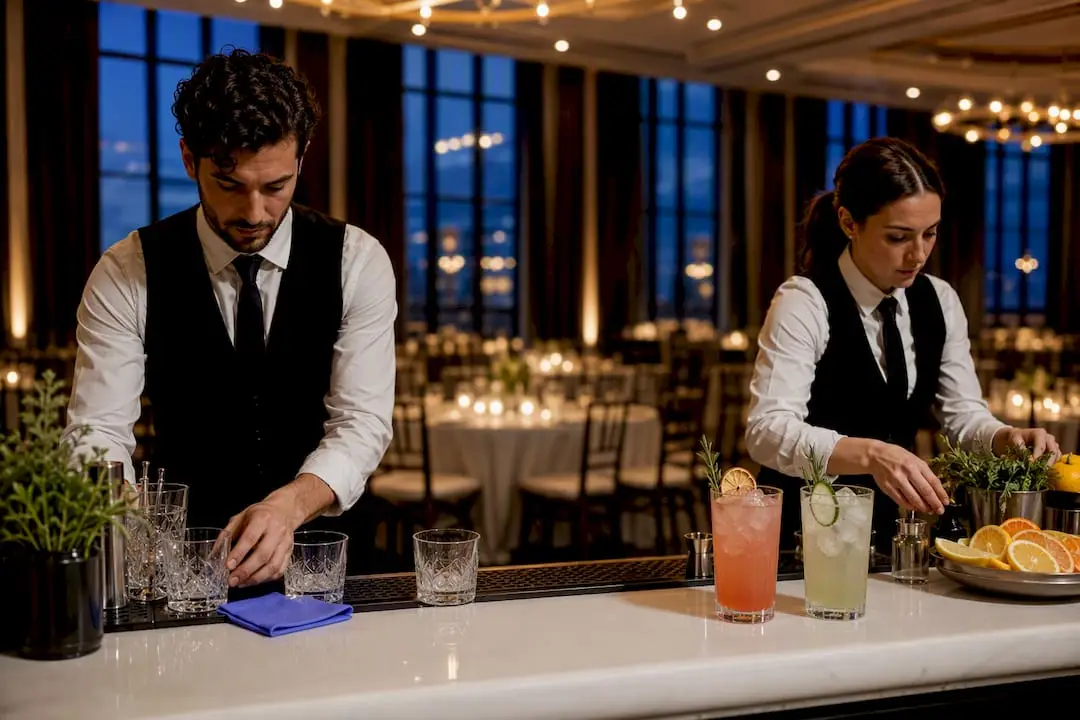
This is where BYOB weddings succeed or fall apart. Insured, professional bartenders don’t just pour drinks, they check IDs, manage the pace of service, and enforce your cutoff time without you having to play bad cop at your own wedding.
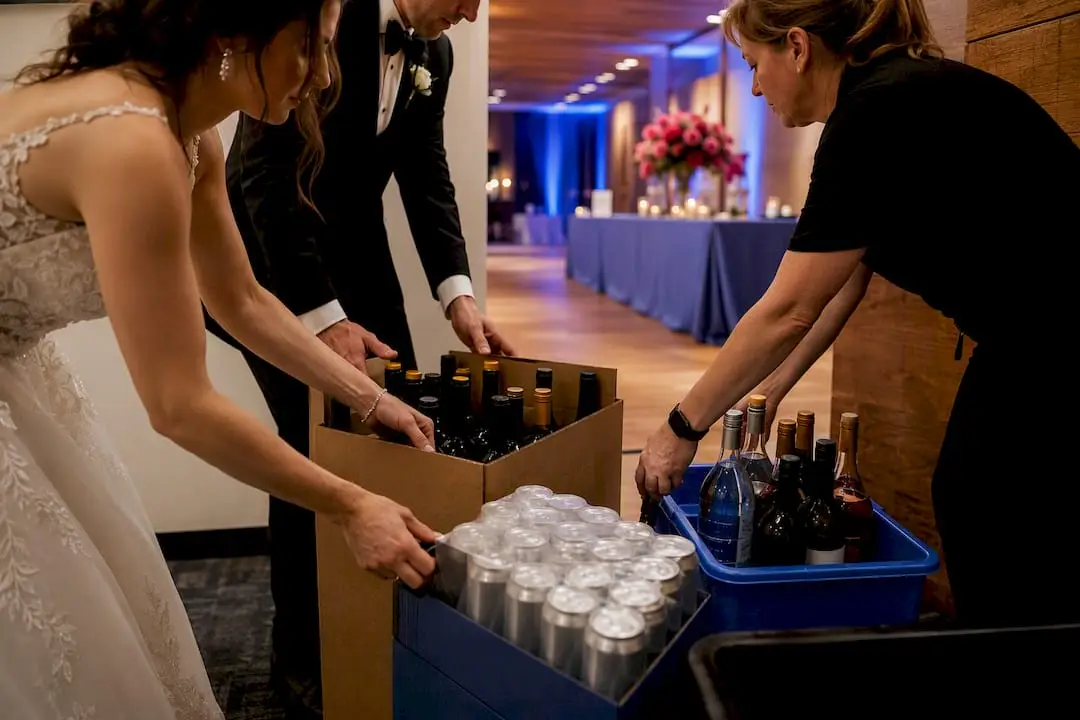
Treat beverage logistics like a vendor shift with a defined schedule, not a pile of tasks that “someone will handle.” That means assigning a specific delivery window, a named point of contact to receive the alcohol, a refrigeration plan, and scheduled restock checkpoints throughout the night, plus someone designated to remove or donate leftovers afterward.
| Task | Who typically handles it |
|---|---|
| Alcohol delivery and receiving | Named family member or planner |
| Chilling and storage | Venue staff or bartending team, per contract |
| Bar setup and staging | Hired bartending team |
| ID checks and service pacing | Licensed bartenders |
| Restocking during the event | Bartending team |
| Breakdown and leftover removal | Bartending team or designated helper |
For staffing, a common guideline is one bartender per 50 to 75 guests for a full bar, adjusted upward for signature cocktails, and staffing ratios shift depending on your bar’s complexity. Budget a reasonable amount of ice per guest, glassware for your peak concurrent drinkers rather than your total guest count, and mixers scaled to whatever spirit-to-mixer ratio your signature drinks call for.
Pro Tip: Assign one non-drinking point person, someone other than the couple, who has the bartender’s number and can approve last-minute decisions. Nobody wants to text the bride about running out of tonic.
How Much Alcohol Should You Actually Buy?
The standard planning rule is one drink per person per hour, with a common alcohol split of roughly 50% liquor, 25% beer, and 25% wine as a starting point, then adjusted for your crowd’s habits and the length of your reception.
Here’s a mini-calculation you can run yourself:
- Guest count × hours of open bar × 1 drink per hour = total drinks needed
- Apply your split (50/25/25 or adjusted for your crowd) across liquor, beer, and wine
- Convert liquor totals to bottles (each 750ml bottle pours about 16 standard cocktails)
- Convert wine to bottles (about 5 glasses per bottle) and beer to cases
- Add a champagne or sparkling wine count for toasts, roughly one glass per guest
For a 100-guest, 5-hour reception, that’s 500 total drinks, which typically nets out to around 15 to 18 bottles of liquor, 8 to 10 cases of beer, and 20 to 25 bottles of wine, adjusted for your actual crowd. Buy from a retailer with a return policy for unopened bottles, and arrange in advance for a family member to donate or take home anything left over. Fewer wasted dollars, less awkward Tuesday-morning cleanup.
How Do You Tell Guests It’s a BYOB or Limited Bar Wedding?
You don’t need to apologize for a curated bar. Simple wedding website language works: “We’re serving a hosted selection of beer, wine, and two signature cocktails” reads as intentional, not cheap.
A few ways to keep it graceful:
- Skip the phrase “BYOB” on invites entirely; it implies guests bring their own, which isn’t what’s happening
- List your signature drinks by name on bar menu signage so guests know their options at a glance
- Offer at least one polished nonalcoholic option alongside the alcohol menu, framed as a feature, not an afterthought
- If family pushes for a bigger bar, offer a compromise like an extra hour of open bar instead of full top-shelf liquor
What Permits Do You Need for a BYOB Wedding?
Permit requirements for BYOB weddings vary significantly by state, county, and even venue type, so there’s no single national answer here. The TTB maintains links to every state’s alcohol beverage control board, and that’s your starting point for confirming what applies to your specific location.
In most states, a private residence or private estate hosting a closed, invitation-only wedding where no alcohol is sold does not require the couple to hold a liquor license. The alcohol is a gift to guests, not a commercial transaction, and that distinction matters legally. The moment money changes hands for drinks, even indirectly through a cash bar or a per-drink charge, you’ve likely crossed into needing a temporary event permit or a licensed caterer/bartender to pour under their existing license.
Some states and counties require a temporary one-day event permit even for private, non-commercial gatherings if alcohol is served at a rented public venue, a park, or certain event spaces. Others exempt private events entirely. County-level rules can differ from state rules, so check both.
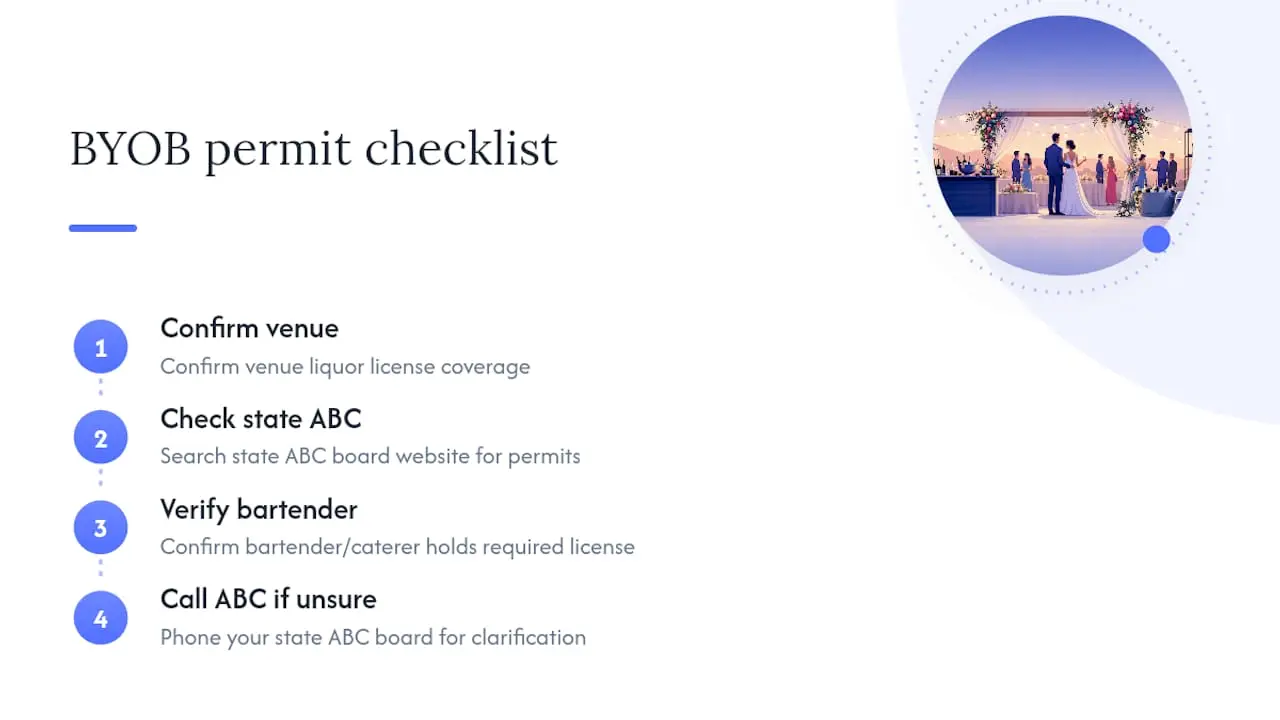
Steps worth taking in order: confirm with your venue whether they hold a liquor license that covers your event; check your state ABC board’s website for temporary event permit requirements; ask any bartending service you hire whether they carry their own license or operate under yours; and if you’re unsure, call your state ABC board directly rather than relying on a wedding blog’s general advice, since these rules shift and vary by jurisdiction.
What Happens If Something Goes Wrong at the Bar?
Even a well-planned BYOB bar needs a plan for the moment things don’t go smoothly. Overserved guests, underage drinking attempts, and disputes at the bar are the three most common incidents, and each has a straightforward response if you’ve prepped for it.
Licensed, TIPS-certified bartenders are trained to recognize visible intoxication and to cut off service before a guest becomes a liability, both to themselves and to your host liquor liability coverage. That’s a major reason venues require certified staff rather than a friend pouring drinks. Give your bartending team explicit authority in advance to refuse service without needing your sign-off in the moment. Making them ask permission first defeats the purpose of hiring professionals.
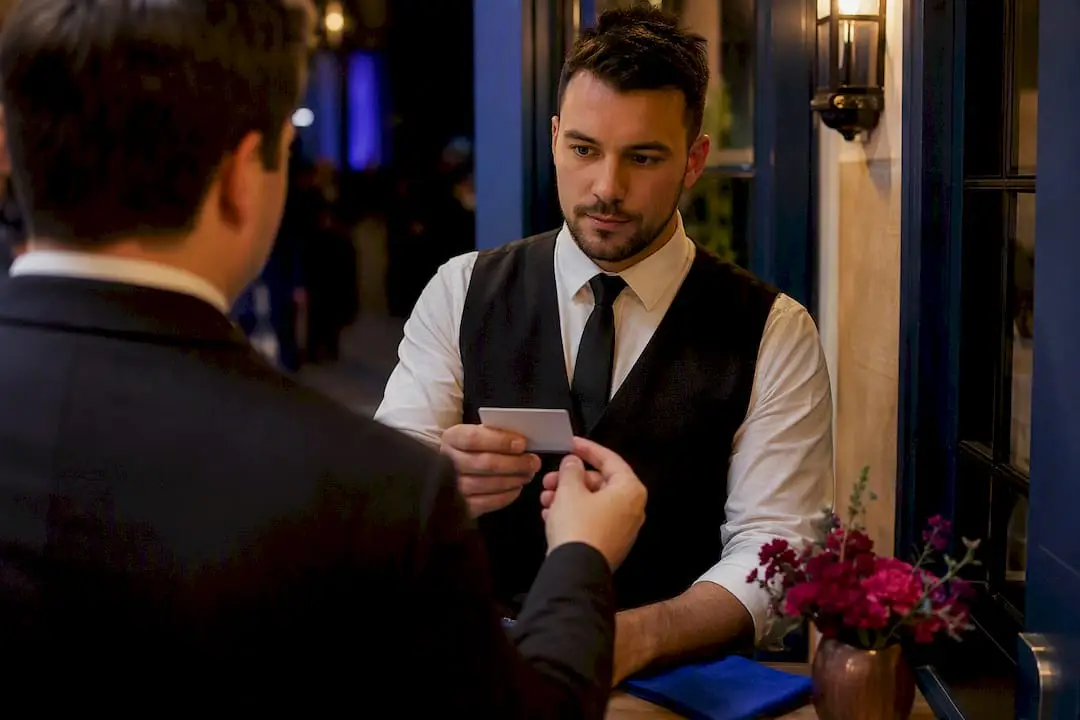
For ID checks, structured BYOB venues typically require bartenders to check identification for anyone who appears under 30, not just guests who look underage. This protects against both underage drinking and liability exposure if an incident occurs later.
If a guest becomes visibly impaired, have a plan ready before the wedding: a designated sober point person (often a wedding planner, family member, or venue coordinator) who can arrange a rideshare or call a taxi, and a quiet space away from the reception where the situation can be handled without disrupting the event. Document any significant incident (time, what happened, who was involved) in case it becomes relevant to an insurance claim later. This is exactly the scenario your host liquor liability policy exists for, and having documentation makes a claims process, if needed, far smoother.
What Should Non-Drinkers and Underage Guests Have to Drink?
A wedding bar built only around alcohol leaves out a meaningful chunk of most guest lists, whether that’s underage cousins, pregnant guests, sober or sober-curious friends, or designated drivers. Treating nonalcoholic options as a real menu category, rather than a sad pitcher of soda at the end of the bar, costs little and improves the experience for a lot of people.
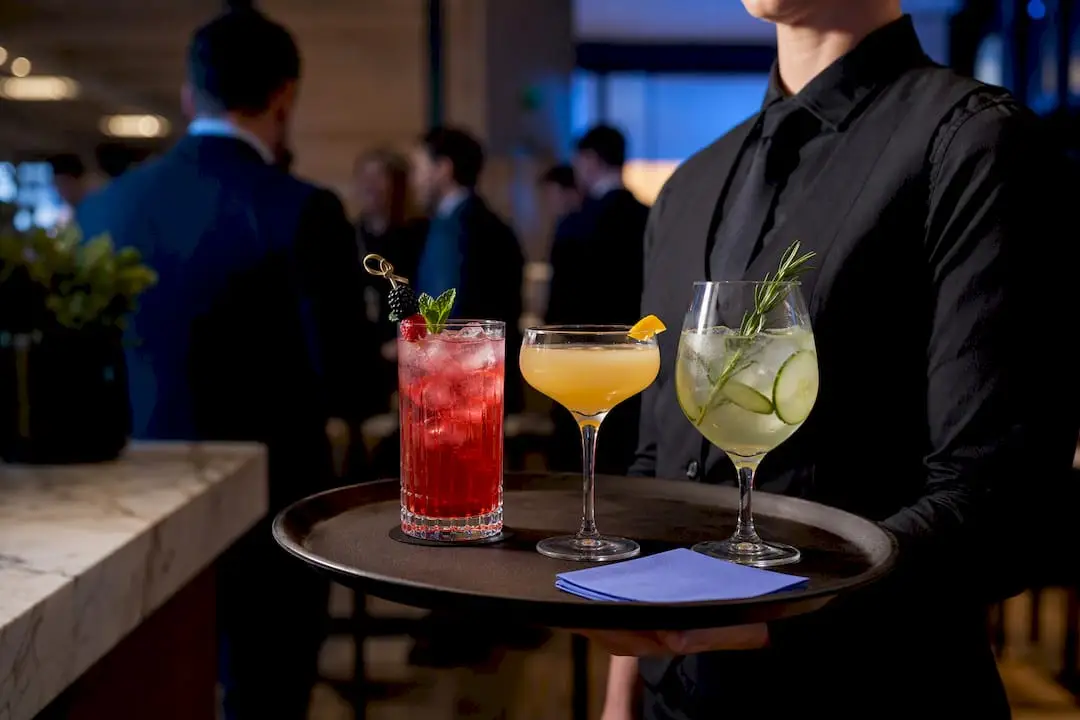
Elevated mocktails built with fresh juice, house-made syrups, and proper garnish read as a genuine menu item rather than a consolation prize, and professional bartenders can build nonalcoholic drinks that match your wedding’s overall drink aesthetic instead of looking like an afterthought. Consider naming at least one or two mocktails on your signage the same way you’d name a signature cocktail.
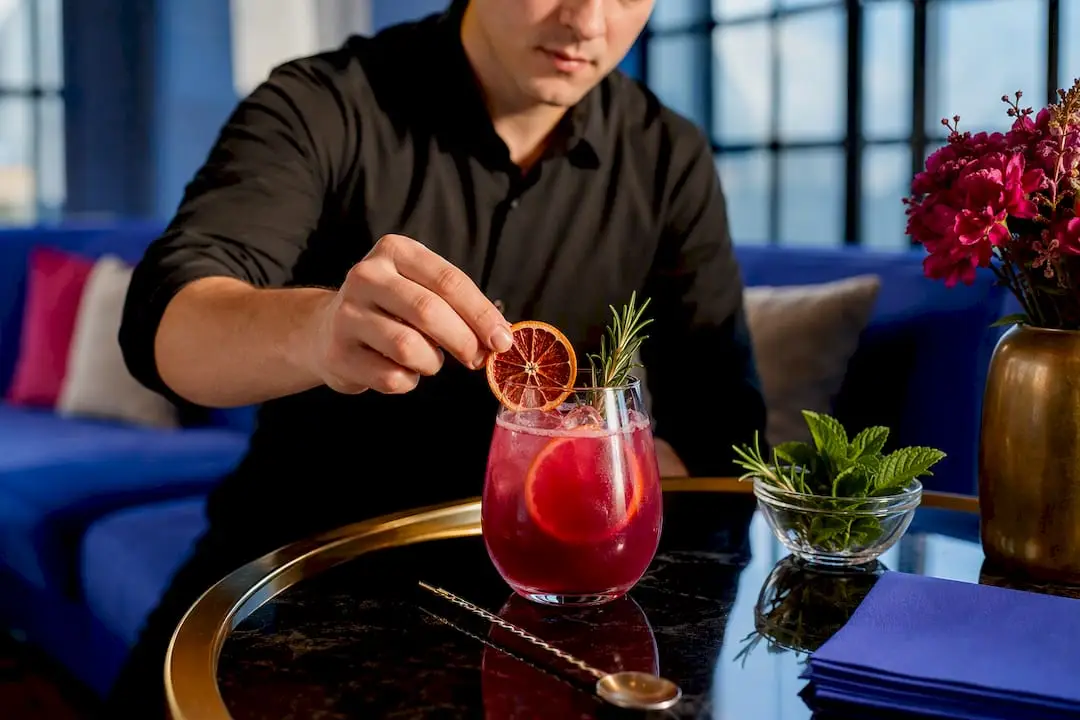
For underage guests specifically, mocktails also double as a discreet way to avoid singling anyone out. Nobody wants to be the only 17-year-old visibly holding a Sprite at the reception while everyone else has a cocktail glass. A well-designed mocktail menu solves that quietly, and it pairs naturally with thoughtful food presentation if you’re coordinating drinks alongside passed appetizers or a dessert table.
Nelson’s Week-Of Checklist and Pro Bartending Perspective
Three things to confirm before you make final payment to anyone: your Certificate of Insurance names the venue correctly, you have confirmed storage and delivery access for the day before or morning of, and your approved vendor list (if required) is finalized in writing.
On the day itself, your bar staff and venue contact need one shared timeline, not two separate ones. Hiring insured professionals isn’t about looking fancy. It’s about handing off the one part of your wedding day where a mistake actually has legal consequences, so you can enjoy the reception instead of managing it. Cocktail Crew’s planning tools exist for exactly this reason.
— Nelson
Let Cocktail Crew Run Your Bar So You Can Run Your Wedding
A structured BYOB wedding gets you real savings without the liability headache when someone else handles the licensing, staffing, and service flow. That’s the gap Cocktail Crew fills for couples across the metro areas we serve: you buy the alcohol, our insured, professional bartenders handle everything from ID checks to cutoff enforcement to breakdown, with a flexible three-hour minimum instead of the rigid, expensive packages most full-service caterers force on you.
Every booking includes access to our cocktail calculator so you’re not guessing at bottle counts, and if part of your guest list skips alcohol, our bartenders build elevated mocktail service into the same setup at no extra staffing complexity. The result is a bar that looks and runs like you hired a full catering team, at a fraction of the cost and none of the liability sitting on your shoulders.
If you’ve got a venue in hand and a guest count locked, request a quote for your date and we’ll walk you through staffing based on your specific bar menu and guest profile.
Sources
- A Planner’s Guide to BYOB Wedding Venues in 2026
- Wedding alcohol calculator and planning guidance
- Planning a BYOB Wedding: Tips For A Fun Celebration