Start with 1 bartender per 50–75 guests as your baseline. For cocktail-heavy events, tighten that to 1 per 35–50. For beer-and-wine-only service, you can stretch to 1 per 75–100. Those three ratios, confirmed across multiple event staffing guides, cover the vast majority of private events.
Quick verdict for common headcounts:
- 100 guests: 2 bartenders (standard); 3 for cocktail-heavy
- 150 guests: 2–3 bartenders (standard); 3–4 for cocktail-heavy
- 200 guests: 3 bartenders (standard); 4–5 for cocktail-heavy
| Guests | Beer & Wine Only | Standard Open Bar | Cocktail-Heavy |
|---|---|---|---|
| 100 | 1–2 | 2 | 2–3 |
| 150 | 2 | 2–3 | 3–4 |
| 200 | 2–3 | 3 | 4–5 |
Key Takeaways
The single most reliable rule for event bar staffing: start at 1 bartender per 50 guests for standard service, tighten to 1 per 35 for cocktail-heavy events, and always staff for your peak 20-minute window, not your event average.
| Point | Details |
|---|---|
| Standard staffing ratio | Start at 1 bartender per 50 guests; adjust to 1 per 35 for cocktail-heavy menus. |
| Three triggers for extra staff | Add a bartender when arrivals are single-wave, the menu is complex, or the event exceeds four hours with a late-night peak. |
| Barback before bartender | Once you have 2+ bartenders, add a barback first — it costs less and solves most restocking bottlenecks. |
| Cut lines without adding staff | Pre-batched cocktails, pre-poured welcome drinks, and a dedicated beer/wine station reduce peak demand significantly. |
| Cocktail-crew calculator | Use the Cocktail-crew cocktail calculator to convert your guest count into a staffing number and shopping list. |
Table of Contents
- How many bartenders do you need for 100, 150, and 200 guests?
- What factors actually change how many bartenders you need?
- Barbacks, runners, and servers: who else do you need?
- How does bar layout and service model affect staffing?
- How do you translate guest count into expected drink volume?
- What do bartenders cost, and what minimums should you expect?
- Practical tactics that cut wait times without adding staff
- How Cocktail-crew staffs events: the calculator and real-world rules
- The mistakes planners keep making (and three rules that fix them)
- Cocktail-crew handles the staffing math so you do not have to
- Sources
How many bartenders do you need for 100, 150, and 200 guests?
The table above gives you the starting point. Here is how to read the ranges and scale beyond 200 guests.
Event staffing guidance from Culinary Eye recommends treating 50 guests as the base unit: divide your headcount by 50 for a standard open bar, then adjust up or down by one bartender depending on menu and layout. For a 250-guest wedding with a full cocktail menu, that math lands at 5 bartenders minimum.
A few scenario notes worth knowing:
- Low end of the range applies when arrivals are staggered over 30+ minutes, you have two or more bar stations, and the menu is simple (bottled beer, wine, one pre-batched cocktail).
- High end of the range applies when all guests arrive within 15 minutes, there is a single bar, and the menu includes multi-step craft cocktails.
- Scaling formula: divide guest count by 50 (standard) or 35 (cocktail-heavy), then round up. Never round down during peak windows.
Sway’s private-event staffing data adds one useful rule: for events of 80 or more guests, a single centralized bar almost always creates lines. Two stations are the practical minimum at that size, regardless of bartender count.
What factors actually change how many bartenders you need?
The ratio is a starting point, not a fixed answer. These variables move it meaningfully.
Drink menu complexity is the biggest lever. A bartender can pour a beer or wine in under 30 seconds. A hand-shaken craft cocktail with muddled ingredients takes 90–120 seconds. That difference alone cuts throughput by more than half. Abastio’s staffing guide notes that open bars with craft cocktails push toward 1 bartender per 35 guests, while simple service holds at 1 per 50 or beyond.
Guest arrival pattern matters more than most planners expect. If 150 guests arrive over 45 minutes, your peak demand is spread out. If they all walk in from a ceremony at the same moment, you have a 20-minute crush that will overwhelm any understaffed bar. Plan for the worst 20-minute window, not the average.
- Staggered arrivals (30+ min): use the lower end of the staffing range
- Single-wave arrivals (ceremony exit, dinner break): add one bartender above the standard count
- Cocktail hour followed by dinner: staff the cocktail hour at full ratio; you can reduce by one during plated dinner service
Event length and service phases also shift the math. A three-hour cocktail party runs at full intensity the entire time. A five-hour wedding reception has a cocktail hour, a dinner lull, and a late-night dance floor rush. Staffing all three phases identically wastes money during dinner and creates lines during the dance floor peak.
Number of bar stations directly affects throughput. Two bars serving 150 guests each handle 75 guests per station, which is far more manageable than one bar handling all 150. Liveforce’s event staffing benchmarks confirm that station count is as important as bartender count when calculating effective service ratios.
Pro Tip: If your venue has a natural traffic chokepoint (a single hallway, a narrow patio entrance), place a secondary bar or a pre-poured welcome drink station right at that entry point. You will cut perceived wait time before guests even reach the main bar.
Barbacks, runners, and servers: who else do you need?
Adding a barback is often smarter than adding a full bartender, especially once you have two or more bartenders working.
- Bartender: mixes, pours, and serves drinks directly to guests. The skilled, licensed role.
- Barback: restocks ice, bottles, and garnishes; washes glasses; keeps the bar organized. Frees the bartender from leaving the station.
- Runner/server: carries drinks from the bar to tables or circulates with trays during cocktail hour. Reduces bar crowding by bringing drinks to guests.
- Event server: handles food and general guest flow, but can double as a drink runner when needed.
A standard ratio is 1 barback per 2–3 bartenders for a busy full-bar event. At a 200-guest cocktail-heavy event with 4 bartenders, that means 1–2 barbacks. Abastio’s role-by-role breakdown makes the case clearly: a barback can add the equivalent of 20–30% more bartender output by eliminating the restocking trips that pull a bartender off the line.
When should you add a barback instead of another bartender? When your bartenders are skilled and fast but constantly running out of ice, glasses, or garnishes. That is a logistics problem, not a throughput problem.
How does bar layout and service model affect staffing?
The physical setup of your bar is a staffing decision. Get it wrong and no amount of extra staff fixes the bottleneck.
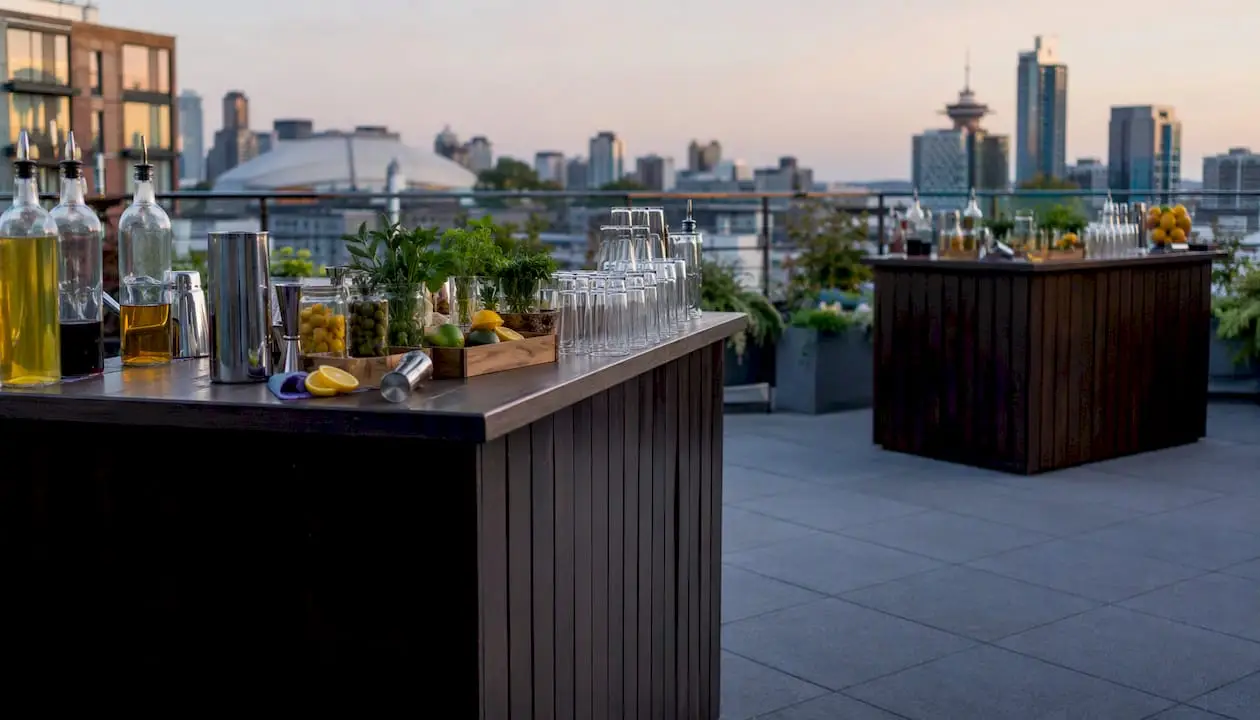
Single centralized bar works for events under 75 guests with simple service. Above that, one bar creates a natural funnel that concentrates wait times regardless of how many bartenders are behind it.
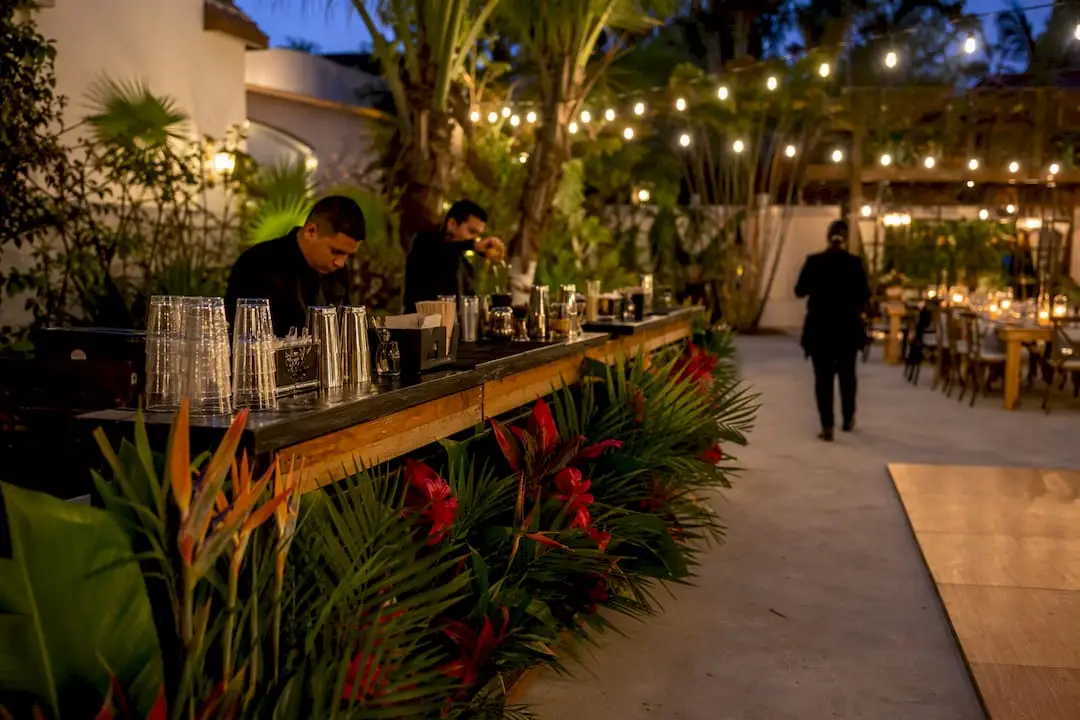
Multiple stations split demand. Two bars at a 150-guest event each handle 75 guests, which is well within the standard ratio even with one bartender per station. The tradeoff is setup cost and the need for duplicate supplies at each station.
Roaming bartenders with trays work well during cocktail hours. They reduce bar crowding by bringing drinks directly to guests, which means your stationary bar handles fewer people at once. This is worth considering for mobile bar setups where flexibility is part of the service model.
Self-serve stations (beer taps, wine stations) handle low-complexity drinks without any bartender time. Place one near a secondary traffic area and it functions as a pressure valve during peak windows.
A few layout rules that consistently improve throughput, drawn from Eventplanning:
- Position bars away from entrances and dance floors to prevent crowding at high-traffic zones.
- Use clear signage so guests know where each bar is and what it serves.
- Keep the back bar (bottles, ice, garnishes) within arm’s reach of every bartender position.
- Separate the payment or ticket station from the pour station when using a cash bar.
How do you translate guest count into expected drink volume?
The standard planning estimate is 1–2 drinks per person per hour, with 1.5 as the practical midpoint for a mixed adult crowd at a social event. A four-hour reception for 150 guests produces roughly 900–1,200 drinks total.
Here is how that translates into bartender workload:
| Scenario | Drinks/Hour (Peak) | Bartenders Needed | Drinks per Bartender/Hour |
|---|---|---|---|
| 100 guests, beer & wine | roughly 100 to 150 | about 2 | roughly 50 to 75 |
| 150 guests, standard open bar | roughly 150 | about 3 | roughly 50 to 75 |
| 200 guests, cocktail-heavy | roughly 300 | about 5 | roughly 60 to 80 |
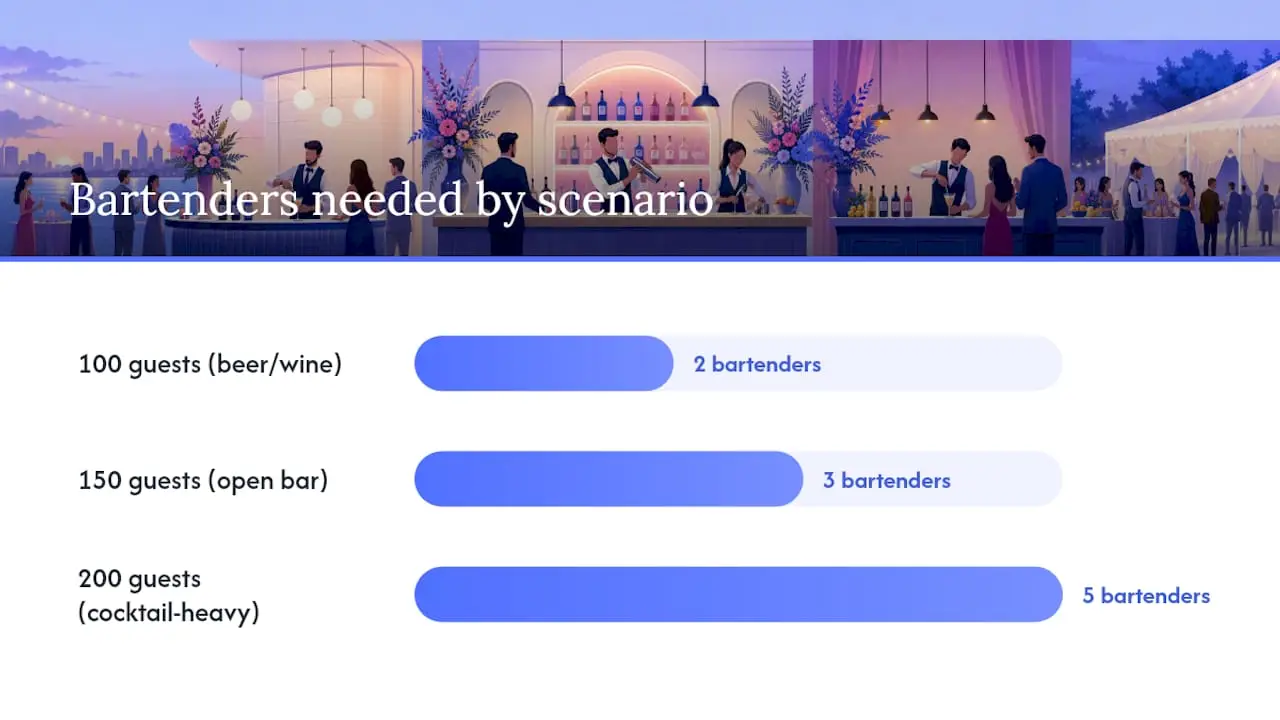
A skilled bartender can pour about 60 to 80 drinks per hour for simple service (beer, wine, pre-batched cocktails). For hand-shaken cocktails, that number decreases to around 30 to 40 per hour. Those throughput numbers are why menu complexity changes staffing requirements so dramatically.
Monica Browne Weddings’ planning guide puts it plainly: two bartenders for 100 guests is the practical minimum for cocktail service, and even that assumes a reasonably efficient setup. One bartender for 100 guests at a cocktail party will produce visible lines within the first 15 minutes of service.
During a 30-minute peak window with 150 guests and only 2 bartenders, each bartender needs to serve 75 guests. At 60 drinks per hour, that is one drink per guest in 30 minutes, which works for beer and wine but leaves no margin for cocktails or any service interruption.
What do bartenders cost, and what minimums should you expect?
Bartender pricing varies by market, but the structure is consistent. Most professional bartending services charge an hourly rate per bartender, with a minimum number of hours (often three to four hours) regardless of actual event length. Cocktail-crew’s three-hour minimum is typical of professional services and reflects setup and breakdown time that happens outside the event itself.
When comparing vendors, ask these questions before signing anything:
- Does the hourly rate include setup and breakdown, or are those billed separately?
- What is the overtime rate if the event runs long?
- Are supplies (ice, garnishes, mixers) included, or quoted separately?
- Is gratuity included in the quote, or expected on top?
- What is the travel fee for your venue location?
Adding a barback typically costs less per hour than a full bartender, which makes the barback-versus-bartender decision a budget question as much as a logistics one. For detailed pricing benchmarks by market, the bartender cost guide for private events breaks down what to expect across different event types and sizes.
When evaluating combined food and beverage staffing, event food service planning resources can help you coordinate catering and bar staff costs together rather than treating them as separate line items.
Practical tactics that cut wait times without adding staff
Sometimes the answer is not more bartenders. It is a smarter setup.
- Batch signature cocktails before the event. A pre-mixed pitcher of a signature drink pours in seconds. Batch cocktail prep can cut bartender workload by 30–40% during cocktail hour.
- Pre-pour wine and champagne for arrival and toasts. Guests pick up a glass on the way in; the bar handles the complex orders.
- Add a dedicated beer-and-wine station separate from the main bar. Guests who want simple drinks skip the cocktail line entirely.
- Use cashless or ticket-based payment if running a cash bar. Handling cash is one of the biggest throughput killers.
- Stagger guest flow by opening a secondary room or outdoor area before directing everyone to the main bar.
- Post clear drink menus at each station. Guests who know what is available before they reach the bar order faster.
Pro Tip: Place a tray of pre-poured welcome drinks (a single signature cocktail or sparkling wine) at the venue entrance. It eliminates the first-wave rush entirely and gives guests something in hand while the bar settles into its rhythm.
Roaming servers with drink trays during cocktail hour are another high-impact move. Service quality in hospitality settings consistently shows that proactive service (bringing drinks to guests) outperforms reactive service (guests queuing at a bar) on guest satisfaction measures.
How Cocktail-crew staffs events: the calculator and real-world rules
Cocktail-crew operates with a three-hour service minimum, which covers setup, peak service, and breakdown. For planners, that minimum is the baseline to build from, not the ceiling.
The Cocktail-crew cocktail calculator converts your guest count, drink menu, and event length into a staffing recommendation and a shopping list. It is the fastest way to move from “how many bartenders per guest?” to a concrete number with supply quantities attached.
The internal checklist Cocktail-crew uses when deciding whether to add a bartender versus a barback:
- Is the bottleneck at the pour (slow mixing)? Add a bartender.
- Is the bottleneck at restocking (empty ice, glasses, garnishes)? Add a barback.
- Is the bottleneck at the bar entrance (crowding, no clear queue)? Add a station or a roaming server.
- Is the event longer than four hours with a late-night peak? Staff the peak window, not the average.
For weddings specifically, wedding bartending guidance from The Knot reinforces what Cocktail-crew sees in practice: beer-and-wine receptions need meaningfully fewer staff than full cocktail menus, and the ceremony-to-reception transition is the single highest-risk moment for bar lines.
The mistakes planners keep making (and three rules that fix them)
Most bar service problems trace back to three decisions made weeks before the event.
Understaffing the peak window is the most common. Planners calculate average demand across the full event and staff for that average. But guests do not drink at a steady average rate. They drink heavily during the first 30 minutes, slow during dinner, and spike again on the dance floor. Staff for your worst 20-minute window, not your four-hour average.
Relying on a single central bar is the second mistake. A single bar is a single point of failure. One slow order, one supply run, one equipment issue and the entire line stops. Two smaller bars are more resilient than one large bar, even with the same total bartender count.
Ignoring the arrival pattern is the third. A staggered arrival over 45 minutes is a completely different staffing problem than 200 guests walking in from a ceremony at the same moment. Ask your venue coordinator exactly how guests will arrive, and staff accordingly.
Three rules worth memorizing:
- Divide guest count by 50 for standard service; divide by 35 for cocktail-heavy events.
- Add one bartender any time all guests arrive within 15 minutes of each other.
- Add a barback before adding a second bartender if you already have two or more bartenders working.
Cocktail-crew handles the staffing math so you do not have to
Figuring out the right number of bartenders per guest is one thing. Finding licensed, experienced professionals who show up prepared, engage your guests, and keep the bar running through a late-night peak is another problem entirely.
Cocktail-crew brings licensed bartenders to private events across multiple metro areas, with a three-hour minimum that covers setup through breakdown. The menu goes beyond standard cocktails: elevated mocktails for sober-curious guests, optional mixers packages for smaller events, and a cocktail calculator that turns your headcount into a staffing plan and shopping list in minutes. The brand has been featured on Shark Tank and carries strong reviews from hosts who needed bar service that actually worked under pressure.
Book your event bartending or run your guest count through the Cocktail-crew cocktail calculator to get a staffing recommendation before your next planning call.
Sources
- How Many Bartenders Do I Need for 100, 150, or 200 Guests? — Culinary Eye
- How to Calculate Staffing Ratios for Events – Liveforce
- Event Staff-to-Guest Ratios by Service Role | Abastio
- Sway – Private Event Staffing Ratios by Format and Guest Count