Bartender cost is defined as the total price a host pays to hire professional bartending services, covering labor, supplies, equipment, and service level for a private event. Hiring a staffing-only bartender typically runs $35–$90 per hour, while full-service mobile bartending packages range from $500 to $2,500 per event. Those two numbers alone tell you almost nothing useful for budgeting. The real figure depends on guest count, service model, hidden fees, and gratuity. This guide breaks down every variable so you can build an accurate budget before you book.
What are typical bartender hourly rates and package costs?
The bartender hourly rate you pay depends almost entirely on which service model you choose. Labor-only hire sits at the low end. Full-service packages cost more upfront but bundle in supplies and logistics.
Labor-only rates
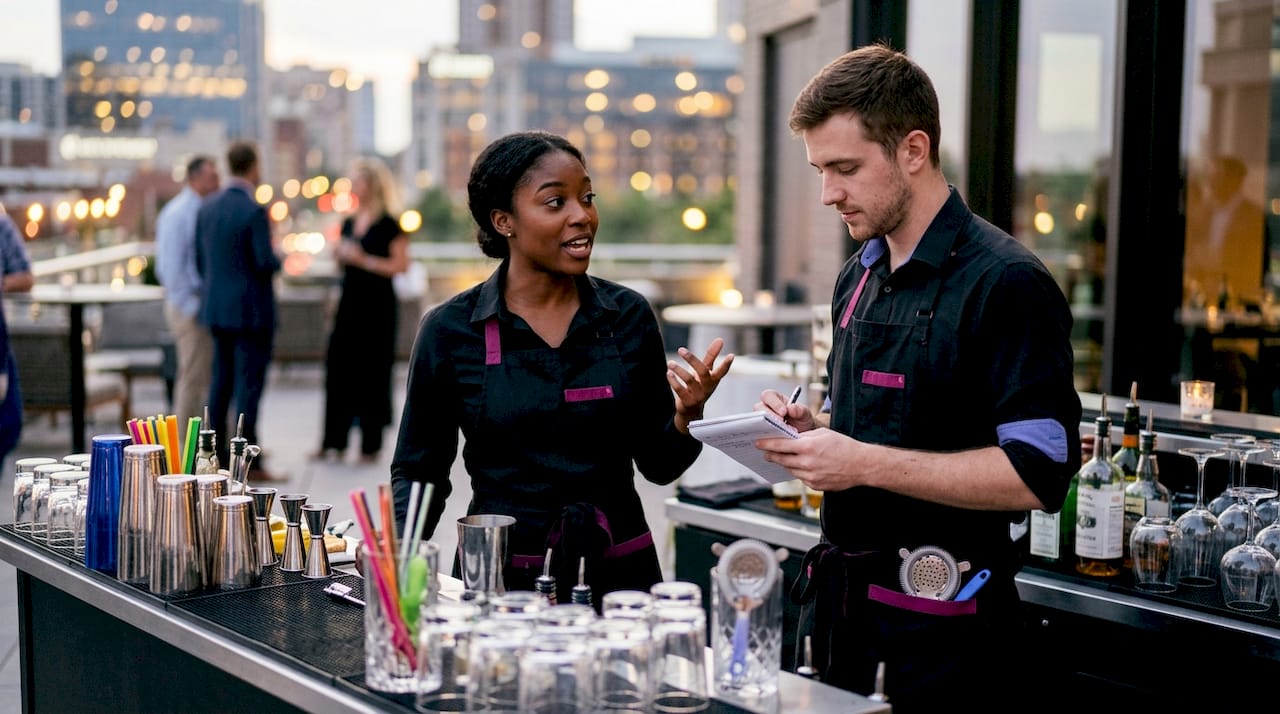
A staffing-only bartender charges for their time and skill, nothing else. You supply the alcohol, mixers, ice, and glassware. Rates range from $35 to $90 per hour, with experienced or TIPS-certified bartenders landing at the higher end. TIPS (Training for Intervention ProcedureS) is the leading responsible alcohol service certification in the United States. Certified bartenders command premium rates because they reduce your liability exposure.
Event package pricing by guest count
For a standard four-hour event, costs scale predictably with headcount:
| Guest count | Labor-only cost | Full mobile bar package |
|---|---|---|
| 50 guests | $350–$650 | $1,800–$2,900 |
| 100 guests | $700–$1,100 | $2,200–$3,600 |
| 150 guests | $1,100–$1,500 | $2,500–$4,400 |
These figures come from published cost breakdowns for private events and reflect labor plus standard supplies where applicable. The gap between labor-only and full-package pricing narrows as guest count rises, because wholesale supply savings offset the package premium at scale.
Pricing tiers at a glance
- Budget tier ($35–$50/hr): Entry-level bartenders, basic service, no extras
- Standard tier ($50–$75/hr): Experienced bartenders, standard cocktail menu, reliable execution
- Premium tier ($75–$120/hr): Craft cocktail specialists, event coordination, brand-forward beverage programs
Premium bartenders at $75–$120 per hour often manage alcohol quantities, prevent long lines, and coordinate with catering staff. That coordination value is real at events with 100 or more guests.
Which factors push bartender prices higher?
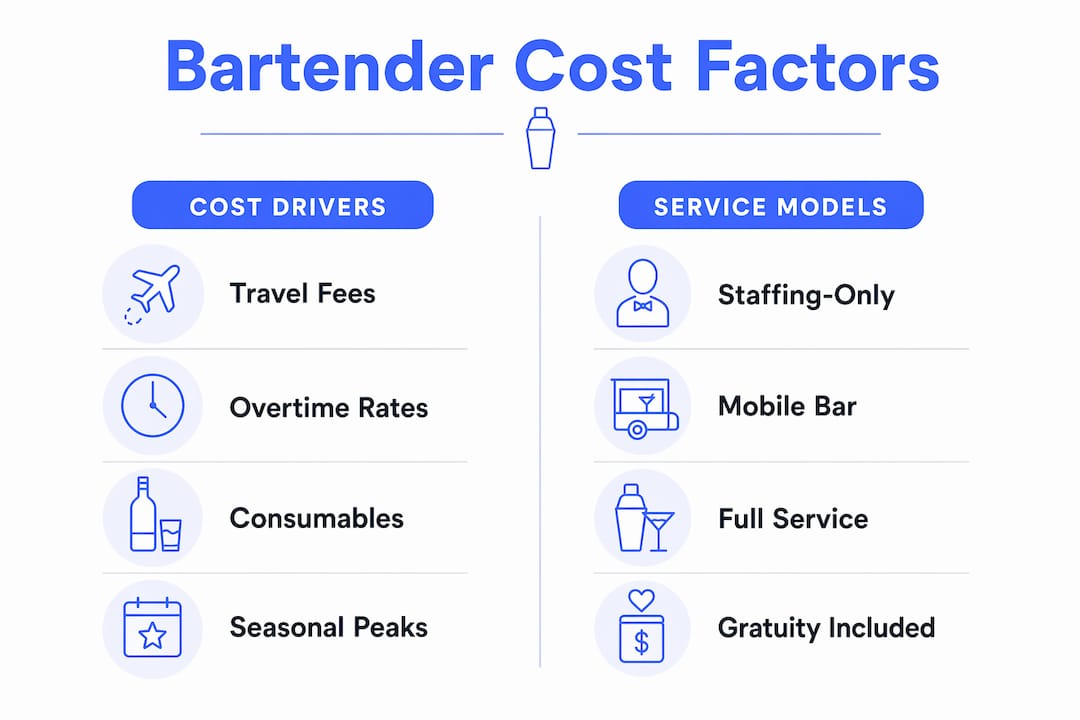
Base rates are just the starting point. Several variables can add 20–50% to your final invoice if you do not account for them during planning.
Travel and location fees. Venues beyond 25 miles from the bartender’s base often trigger travel surcharges of 15–30%, plus flat fees of $50–$150 in rural areas. Always ask for a mileage policy before signing a contract.
Overtime and late-night rates. Events running past 10:00 PM typically incur overtime at 1.5x the base hourly rate. Setup and teardown time is sometimes billed separately, so clarify whether the quoted hours include both.
Consumables. Budget approximately 2 lbs of ice per guest. Mixers, garnishes, and glassware add up fast. Liability insurance runs $25–$125 per event, and consultation fees range from $50–$150. These line items are often excluded from the headline quote.
Peak season and event timing. June, october, and december weddings command premium pricing. Corporate holiday parties in november and december face the same surge. Book early and ask whether off-peak dates carry a discount.
Gratuity. Bartenders expect 15–20% gratuity on top of quoted prices. In 2026, built-in contractual gratuity of around 18% is the preferred standard over tip jars. Budget for this separately so it does not catch you off guard at checkout.
Pro Tip: Ask every vendor to send a fully itemized quote that includes travel, setup, teardown, consumables, insurance, and gratuity. A quote missing those line items is incomplete, and the difference can be hundreds of dollars.
How do different service models compare in cost and value?
Three distinct service models exist for private event bartending. Each carries a different price point, scope of work, and set of hidden costs.
Staffing-only bartender
You hire the person, not the bar. The bartender shows up, works your event, and leaves. You handle all purchasing, setup, and cleanup. This model suits hosts who already own or rent bar equipment and want full control over their alcohol selection. The risk is supply miscalculation. Last-minute substitutions are a common failure point, and running out of ice at 9:00 PM is a real problem.
Mobile bar vendor
A mobile bar vendor brings the bar itself, often a custom-built unit, along with glassware, ice, mixers, and garnishes. Full-service mobile bartending includes bar setup, supplies, and insurance in one package. The upfront cost is higher, but the host’s workload drops significantly. Mobile bar vendors also frequently access wholesale pricing on consumables, which can offset the package premium compared to buying retail for a dry hire setup.
Full cocktail catering service
This model adds menu design, custom cocktail development, and full event coordination to the mobile bar model. It suits weddings, corporate launches, and high-profile gatherings where the bar program is a centerpiece. Pricing is the highest of the three tiers, but the value per dollar is strong when the beverage experience is part of your event’s brand. Cocktail-crew operates in this space, offering charismatic bartenders who engage guests and manage the full bar experience from start to finish.
| Service model | What’s included | Best for | Watch for |
|---|---|---|---|
| Staffing-only | Labor only | Small, controlled events | Supply gaps, no insurance |
| Mobile bar vendor | Bar, supplies, labor | Mid-size events, 50–150 guests | Setup fees, travel costs |
| Full cocktail catering | Full program + coordination | Weddings, corporate events | Higher base price |
For events with 100 or more guests, the right bartending service is rarely the cheapest one. Coordination failures at scale cost more in guest experience than the price difference between tiers.
How to estimate your total bartender budget
A reliable budget follows a clear sequence. Work through these steps before requesting any quotes.
-
Determine your guest count. Most private events need one bartender per 50–75 guests for standard service. Craft cocktail menus or high-volume events require one bartender per 40–50 guests, sometimes with a barback for support. A 100-guest cocktail party likely needs two bartenders minimum.
-
Choose your service model. Decide between staffing-only, mobile bar, or full catering before pricing anything. The model determines which costs fall on you versus the vendor.
-
Calculate base labor. Multiply your bartender count by the hourly rate and event duration. Add one hour for setup and one for teardown if those are billed separately.
-
Add consumables. If you are doing a dry hire, budget 2 lbs of ice per guest, plus mixers, garnishes, and glassware. For a 100-guest event, consumables alone can run $300–$600 at retail prices. Mobile bar vendors who use wholesale supply access often deliver better value here.
-
Include insurance and consultation. Add $25–$150 for liability insurance and $50–$150 for a pre-event consultation if those are not bundled.
-
Add gratuity. Apply 18–20% to the total labor cost. Do not skip this line item.
-
Request itemized quotes from at least three vendors. Compare line by line, not headline totals. A lower headline price with unbundled consumables often costs more in the end.
Pro Tip: Send vendors a finalized shopping list at least 48 hours before your event. Last-minute changes are the single most common cause of bar service failures on event day.
A common budgeting mistake is treating the quoted rate as the final number. For a 100-guest, four-hour event using a mobile bar vendor, a realistic all-in budget including gratuity, travel, and consumables sits closer to $3,000–$4,500. Plan for that range, not the base package price.
You can also use Cocktail-crew’s cocktail calculator to estimate drink quantities and costs before you ever contact a vendor. It removes the guesswork from supply planning entirely.
Key Takeaways
Hiring a bartender for a private event costs far more than the hourly rate suggests once you add supplies, travel, gratuity, and service model differences into the calculation.
| Point | Details |
|---|---|
| Base rates vary widely | Labor-only bartenders charge $35–$90 per hour; full packages run $500–$2,500 per event. |
| Guest count drives staffing | Plan one bartender per 50–75 guests for standard service, or one per 40–50 for craft cocktails. |
| Hidden costs add up fast | Travel fees, overtime, consumables, insurance, and gratuity can add 20–50% to your base quote. |
| Service model changes the math | Mobile bar vendors offer wholesale supply savings that can offset higher upfront package costs. |
| Get itemized quotes | Compare line-by-line costs across at least three vendors before committing to any contract. |
What I’ve learned about bartender budgets after years of events
The most expensive mistake hosts make is treating bartender cost as a single number. They see a $75-per-hour rate, multiply by four hours, and write $300 into their budget. Then the invoice arrives at $900. The gap is always the same: travel, setup, consumables, and gratuity were never discussed.
The second mistake is undervaluing experience. A bartender charging $90 per hour who manages event flow and prevents a 20-minute drink line at your wedding cocktail hour is worth more than two $45-per-hour bartenders who need supervision. Event coordination is a skill, and it is priced into premium rates for a reason.
The third thing I have seen repeatedly: hosts who skip the pre-event consultation. That $50–$150 fee is not overhead. It is the conversation where your bartender learns your guest count, your menu, your venue layout, and your timeline. Events without that conversation run into supply problems, timing gaps, and service inconsistencies that no amount of skill can fix on the fly.
The hosts who get the best value are the ones who treat their bartender as a vendor partner, not a commodity. Share your full event details early. Ask for a complete itemized quote. Confirm gratuity expectations in writing. Those three habits alone eliminate most of the budget surprises I have seen derail otherwise well-planned events.
— Nelson
Cocktail-crew: transparent pricing for your next event
Planning a private event means managing a dozen moving parts at once. The bar should not be one of the stressful ones.
Cocktail-crew offers professional bartending services for private events of all sizes, from intimate birthday gatherings to large corporate functions. Their bartenders are charismatic, experienced, and trained to keep service moving at any guest count. With a minimum booking of just three hours, you get flexibility that most full-service providers do not offer. Cocktail-crew also builds in transparent, itemized pricing so you know exactly what you are paying for before you sign. See how professional bartending services can change the experience at your next event, and use their cocktail calculator to start building your budget today.
FAQ
How much does a bartender cost for a party?
For a standard four-hour private party, labor-only bartending costs $350–$650 for 50 guests, while full mobile bar packages for the same event run $1,800–$2,900. Add gratuity, travel, and consumables to reach your true all-in cost.
What is the average bartender hourly rate for private events?
Bartender hourly rates for private events range from $35 to $90 per hour for labor-only hire, with premium craft cocktail specialists charging $75–$120 per hour.
How many bartenders do I need for my event?
One bartender per 50–75 guests covers standard service at most private events. Craft cocktail menus or high-volume bars require one bartender per 40–50 guests, sometimes with a barback.
Should I tip my bartender on top of the quoted price?
Yes. Bartenders expect 15–20% gratuity on top of the quoted rate. In 2026, most professional services build an 18% contractual gratuity into the contract rather than relying on tip jars.
What is the difference between a private bartender and a mobile bar vendor?
A private bartender provides labor only. You supply everything else. A mobile bar vendor brings the bar, supplies, and insurance as a bundled package. Mobile vendors cost more upfront but reduce the host’s planning burden and often save money on consumables through wholesale pricing access.