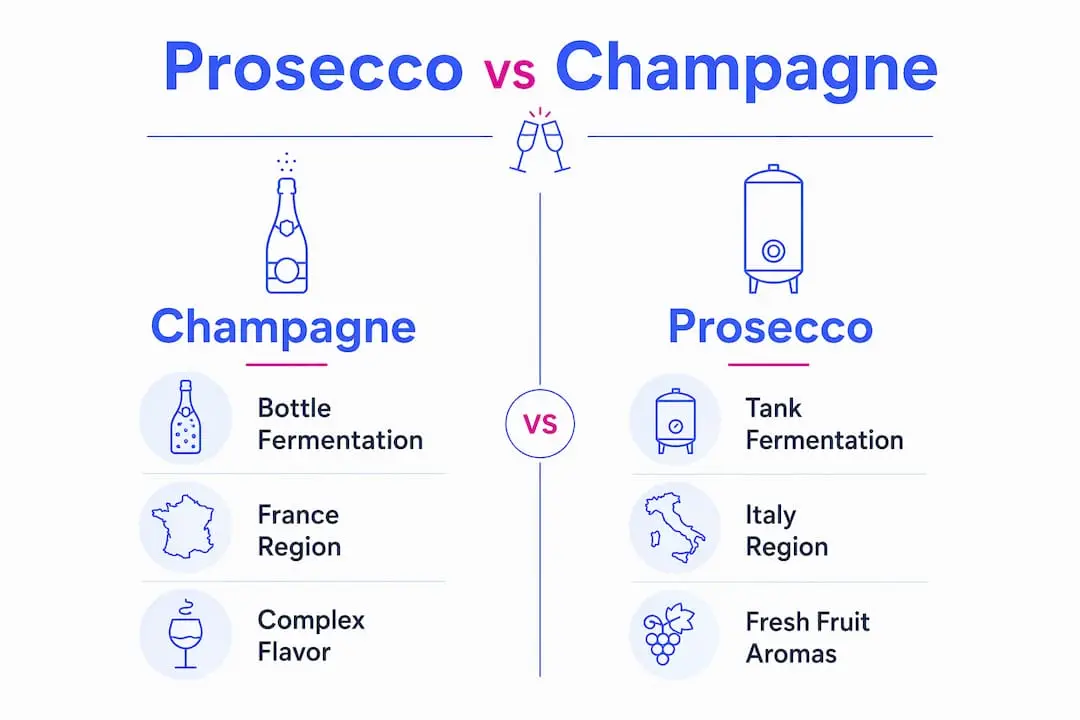
Champagne is a legally protected sparkling wine made exclusively in France’s Champagne region using secondary fermentation inside each individual bottle. Prosecco is an Italian sparkling wine from the Veneto, made in large pressurized tanks using the Charmat method. That single production difference shapes everything: flavor, texture, price, and when you’d reach for one over the other.
Choose Champagne when:
- You want toasty, complex flavors and a fine, creamy mousse for a formal toast, fine dining, or a milestone celebration
Choose Prosecco when:
- You want fresh, fruity, floral fizz at a lower price point for mimosas, Aperol Spritzes, or a large casual gathering
For toasts and fine dining, Champagne is worth the splurge. For brunch, cocktails, and any event where you’re buying more than a dozen bottles, Prosecco delivers equal guest satisfaction at a fraction of the cost.
Table of Contents
- What is Champagne and why can’t anyone else use the name?
- What is Prosecco and what do DOC and DOCG mean?
- How do the production methods actually compare?
- What do they actually taste like?
- How to read a label: DOC, DOCG, AOC, vintage, and sweetness terms
- What should you expect to pay at U.S. retail?
- Which one should you pick for your occasion?
- Serving temperature, glassware, and storage
- A bartender’s guide to buying and serving at events
- The history and cultural weight behind each bottle
- Sustainability in the glass: how each region is adapting
- Key Takeaways
- The case for not overthinking it
- Leave the drink decisions to the professionals
- Further reading and authoritative sources
What is Champagne and why can’t anyone else use the name?
Only sparkling wine produced in the Champagne appellation of northeastern France earns the right to call itself Champagne. That is not a marketing claim; it is a legally enforced protected designation under French AOC (Appellation d’Origine Contrôlée) law, and any bottle labeled “Champagne” from outside that region is a violation.
Three grapes do most of the work: Chardonnay, which adds citrus, chalk, and elegance; Pinot Noir, which contributes body, red fruit, and structure; and Pinot Meunier, which rounds out the blend with softer, fruitier notes. Producers blend these in different proportions to build a house style, and the best houses maintain that style across every vintage.
AOC rules also dictate minimum aging. Non-vintage Champagne must age on the lees for at least 15 months; vintage Champagne requires a minimum of three years, though prestige cuvées often spend five to ten years in the cellar. That time costs money, which is the single biggest reason Champagne is expensive.
Quick rule: If the label says “Champagne,” the wine came from Champagne, France. No exceptions.
What is Prosecco and what do DOC and DOCG mean?
Prosecco originates from northeastern Italy, primarily the Veneto region, with its heartland in the hills of Conegliano and Valdobbiadene, roughly 50 miles north of Venice. The base grape is Glera, a semi-aromatic variety that produces wines with delicate floral and fruit aromas. Up to 15% of other permitted varieties, including Verdiso and Perera, may be blended in.
Two quality tiers matter on a label:
- Prosecco DOC: The broader appellation covering a wide production zone across Veneto and Friuli. Most bottles under $20 fall here.
- Prosecco Superiore DOCG (Conegliano–Valdobbiadene): The higher tier, grown on steep hillside vineyards with stricter yield limits. Expect more complexity, better structure, and a price in the $15–$30 range.
Prosecco is designed to be drunk young. Unlike Champagne, it does not benefit from cellaring. The goal is to capture Glera’s fresh aromatics at their brightest, which is exactly why the Charmat method is used rather than bottle fermentation.
How do the production methods actually compare?
This is where the two wines diverge most sharply, and understanding it explains every other difference.
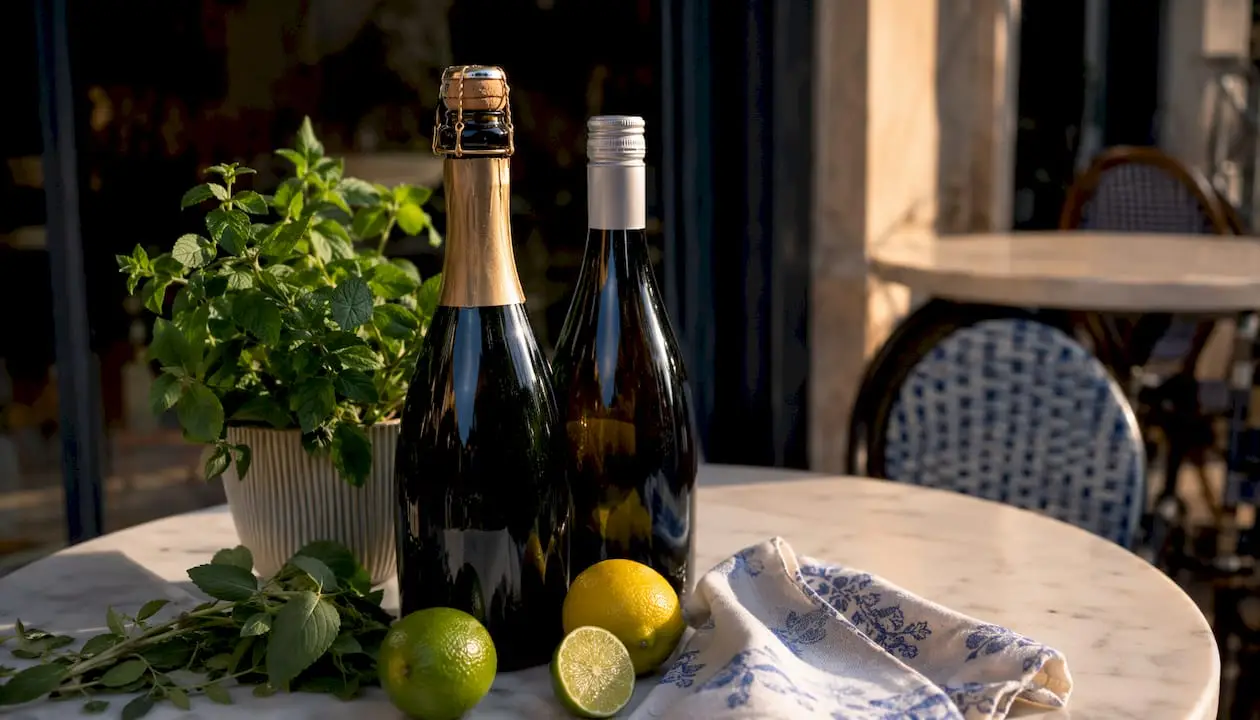
Champagne: traditional method (Méthode Traditionnelle)
A still base wine is bottled with a small dose of sugar and yeast. Secondary fermentation happens inside that sealed bottle, producing CO₂ that dissolves into the wine. The bottle then ages on its lees (dead yeast cells) for months or years. That extended lees contact produces the signature brioche, toast, and nutty notes Champagne is known for. Riddling and disgorgement remove the spent yeast before the final cork goes in.
Prosecco: Charmat method (also called the tank method or autoclave)
The base wine goes into a large pressurized stainless-steel tank, where secondary fermentation is triggered by adding yeast and sugar. Once the target pressure is reached, the wine is chilled to stop fermentation, filtered, and bottled under pressure. The whole process is faster, cheaper, and far less labor-intensive. Critically, the Charmat method preserves Glera’s primary fruit and floral aromatics that long lees contact would mask.
| Dimension | Champagne | Prosecco |
|---|---|---|
| Production method | Traditional (bottle fermentation) | Charmat / tank method |
| Region / appellation | Champagne AOC, France | Prosecco DOC / DOCG, Veneto, Italy |
| Primary grapes | Chardonnay, Pinot Noir, Pinot Meunier | Glera |
| Taste / aroma | Brioche, toast, citrus, chalk, mineral | Pear, green apple, white flowers, stone fruit |
| Sweetness / dosage | Brut Nature to Demi-Sec | Brut Nature to Demi-Sec |
| Pressure | ~5–7 bars | Frizzante: 1–2.5 bars; Spumante: ~5 bars |
| Typical U.S. retail price | $30–$50+ (NV); $80–$200+ (vintage/prestige) | Under $20 (DOC); $15–$30 (DOCG) |
| Best use | Formal toasts, fine dining, milestones | Mimosas, Spritzes, cocktail hours, large events |
The cost gap is structural. Champagne requires individual bottle handling, years of cellar space, and skilled labor for riddling and disgorgement. Prosecco’s tank process is automated and fast.
What do they actually taste like?
Champagne leads with secondary and tertiary aromas built during lees aging: brioche, toast, fresh bread, sometimes honey or hazelnut in older vintages. The base fruit is citrus-forward, with lemon curd, green apple, and chalk-driven minerality underneath. The mousse is fine and persistent, with tiny bubbles that create a creamy, almost silky mouthfeel. That texture makes the wine feel drier than its sugar content suggests.
Prosecco is all about primary aromatics: ripe pear, green apple, white peach, and white flowers like acacia or wisteria. The bubbles are larger and frothier, especially in frizzante styles, and the finish is clean and short. Prosecco frizzante runs 1–2.5 bars of pressure; spumante reaches around 5 bars. Champagne typically sits at 5–7 bars, but the smaller bubble size makes it feel more refined.
On sweetness: Prosecco is generally perceived as slightly sweeter than Brut Champagne, even when both are labeled “Brut.” The fruitier aromatics and softer acidity in Prosecco create that impression. One common point of confusion: “Extra Dry” is not the driest style. It is actually slightly sweeter than Brut. The genuinely dry categories are Brut Nature (0–3 g/L sugar) and Extra Brut (0–6 g/L).
Aging: Non-vintage Champagne is fruitier and more approachable; vintage Champagne develops deeper, more complex flavors over years. Prosecco does not improve with age. Buy it, chill it, drink it within a year or two of release.
How to read a label: DOC, DOCG, AOC, vintage, and sweetness terms
Labels carry more information than most buyers use. Here is what actually matters.
Appellation tiers:
- AOC (France): Appellation d’Origine Contrôlée. For Champagne, this means strict geographic and production rules enforced by the CIVC.
- DOC (Italy): Denominazione di Origine Controllata. Prosecco DOC is the broad tier.
- DOCG (Italy): The “G” stands for Garantita, meaning guaranteed. Prosecco Superiore DOCG from Conegliano–Valdobbiadene is the top tier, with hillside vineyards and tighter rules.
Vintage vs. non-vintage:
- NV (Non-Vintage): A blend of multiple harvest years, designed for consistency. Most Champagne sold in the U.S. is NV. It is the right choice for large events because supply is reliable and the style is predictable.
- Vintage: A single harvest year on the label. Champagne vintage is produced only in exceptional years and commands higher prices. Better for intimate dinners than a 200-person wedding.
Dosage (sweetness) table:
| Category | Sugar (g/L) | What to expect |
|---|---|---|
| Brut Nature | 0–3 | Bone dry, sharp acidity, no perceptible sweetness |
| Extra Brut | 0–6 | Very dry, lean, mineral-forward |
| Brut | 0–6 | Dry with a hint of roundness; most popular style |
| Extra Dry | 0–10 | Slightly sweet; common in Prosecco |
| Sec | 15–20 | Noticeably sweet |
| Demi-Sec | 30–40 | Dessert-friendly sweetness |
Label quality clues for Champagne: Look for “RM” (Récoltant-Manipulant), which identifies a grower-producer making wine from their own vineyards. These are often smaller, terroir-driven bottles that outperform their price. “NM” (Négociant-Manipulant) marks the large houses that buy grapes. For Prosecco, “Rive” on a DOCG label indicates a single-vineyard wine, the closest thing Prosecco has to a premier cru designation.
What should you expect to pay at U.S. retail?
Entry-level Prosecco DOC commonly sells under $20 at most U.S. retailers. Prosecco Superiore DOCG typically runs $15–$30. Non-vintage Champagne from mainstream houses starts around $30–$50. Vintage and prestige cuvées from major houses climb well above that, often into the $80–$200+ range.
The price gap comes down to four factors: labor (bottle fermentation requires hands-on riddling and disgorgement), time (years of cellar aging), yields (Champagne’s AOC rules restrict how many tons of grapes can be harvested per hectare), and the appellation premium that comes with one of the world’s most recognized luxury wine names.
Value guidance:
- Under $20: Prosecco DOC is the clear choice. Several solid bottles exist in this range.
- $20–$40: Prosecco DOCG offers real quality. Entry-level NV Champagne also appears here from lesser-known houses.
- $40+: NV Champagne from recognized houses, or DOCG single-vineyard Prosecco.
- $80+: Vintage Champagne and prestige cuvées. Worth it for a milestone; unnecessary for a brunch.
Pro Tip: For a 50-person party, buying five cases of a $18 Prosecco DOCG will impress more guests than two cases of a $45 NV Champagne. Save the prestige bottle for the toast itself.
Which one should you pick for your occasion?
The right answer depends almost entirely on what you are doing and how many people you are serving.
Formal toasts and milestone celebrations: Champagne. The complexity and prestige signal that the moment matters. One or two bottles for a toast does not break the budget.
Brunch and mimosas: Prosecco, without question. Its fresh fruit profile mixes better with orange juice, and spending $50 on Champagne for a mimosa is a waste of what makes Champagne worth buying.
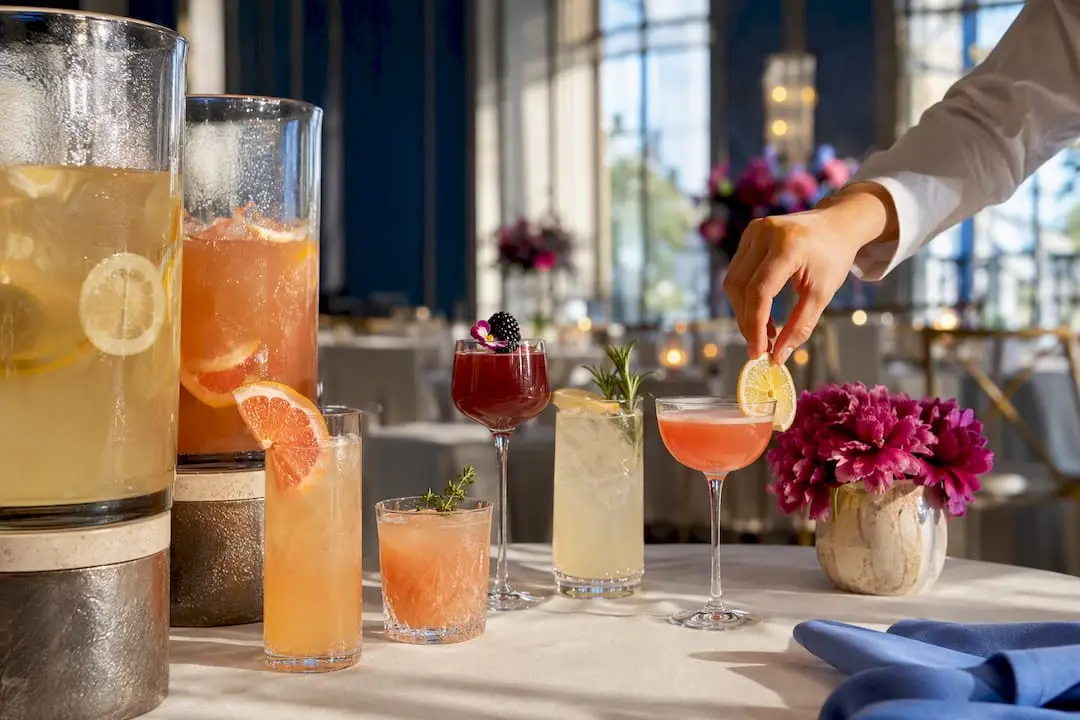
Cocktails (Aperol Spritz, Bellini, Rossini): Prosecco is the correct base for all three. Its light, aromatic style makes it the go-to for cocktail programs at weddings, birthdays, and cocktail hours. Check out creative cocktail trends for weddings for ideas on building a full sparkling cocktail menu.
Large receptions (50+ guests): Prosecco. Budget math is simple: you can serve three times as many guests for the same spend.
Food pairings:
- Champagne: oysters, raw shellfish, fried chicken, aged cheeses, smoked salmon
- Prosecco: prosciutto, melon, light pasta, fresh cheeses, fruit-based desserts
For a venue that takes wine pairing seriously, the team at Rafael’s Lounge Bar in Porto Rafael, Sardinia, shows how matching sparkling wine to the menu and setting elevates the whole experience.
Serving temperature, glassware, and storage
Both wines should be served cold, but not ice-cold. Champagne is best at 47–50°F (8–10°C); serving it too cold mutes the aromas that make it worth drinking. Prosecco is slightly more forgiving at 43–47°F (6–8°C), where its fruit aromatics stay bright.
Glassware matters more than most people think. The classic flute preserves bubbles and keeps the wine cold, but it restricts aroma. A tulip-shaped glass or a standard white-wine glass opens up the nose considerably, especially for Champagne. For Prosecco, a wider tulip lets the floral notes breathe without losing carbonation too quickly.
Storage and open bottles: An open bottle of sparkling wine loses its bubbles within 24 hours. A sparkling wine stopper (not a regular cork) can extend that to 1–2 days in the fridge. Neither Champagne nor Prosecco benefits from long-term home storage unless you have a proper wine cellar. NV Champagne is ready to drink on purchase; Prosecco should be consumed within one to two years of release.
Pro Tip: To chill a bottle quickly, submerge it in a bucket of half ice, half cold water with a handful of salt for 20 minutes. That beats 90 minutes in the fridge and gets the bottle to serving temperature without freezing it.
A bartender’s guide to buying and serving at events
Getting the wine right is one thing. Getting the quantities right is what separates a smooth event from a frantic mid-party liquor-store run.
| Event type | Guests | Bottles recommended | Notes |
|---|---|---|---|
| Toast only | 50 | 8–10 | One pour per guest, ~5 oz each |
| Welcome drinks (1 hr) | 50 | — | Two pours per guest |
| Full cocktail hour (2 hrs) | 50 | 20 | Mix with other beverages |
| Brunch (2–3 hrs) | 30 | — | Higher consumption with mimosas |
A standard 750 mL bottle yields about five 5-oz pours. For a toast-only scenario, plan one bottle per five guests. For a full cocktail hour, one bottle per two to three guests is a safer estimate.
Mixing and cocktail service:
- Prosecco is the right base for Aperol Spritzes (3 parts Prosecco, 2 parts Aperol, 1 part soda), Bellinis (Prosecco and white peach purée), and Rossinis (Prosecco and strawberry purée).
- Champagne works in a French 75 (Champagne, gin, lemon, sugar) or a classic Champagne cocktail (bitters, sugar cube, Champagne). These are premium pours for smaller, more formal events.
Service logistics: Chill bottles for at least three hours before service. Rotate glasses every 30–45 minutes at a large event to keep pours fresh. For events over 40 guests, one dedicated bartender per 50 guests keeps service moving without long waits. A great event bartender also manages waste, tracks consumption, and advises on quantities in real time.
Pro Tip: Always order 10–15% more bottles than your estimate. Returning unopened bottles is easy; running out mid-event is not recoverable.
The history and cultural weight behind each bottle
Champagne’s story begins in earnest in the 17th century, though the myth that Dom Pérignon invented sparkling wine is largely that: a myth. The monk did contribute to refining the blending process, but effervescence in Champagne was initially considered a flaw. By the 18th century, the French aristocracy had reframed it as a luxury, and Champagne became the drink of coronations, treaties, and celebrations. That cultural positioning has held for 300 years. Today, Champagne is synonymous with ceremony in a way no other wine has managed to replicate.
Prosecco’s roots go back centuries in the Veneto, but its modern identity took shape much more recently. The name “Prosecco” was historically tied to a grape variety, not a place. In 2009, Italian authorities renamed the grape “Glera” and converted “Prosecco” into a protected geographic designation, directly mirroring how France protects Champagne. That move locked out New World producers who had been planting the grape and selling it as Prosecco. Since then, Prosecco’s global sales have grown sharply, driven by its accessibility, its role in the Aperol Spritz phenomenon, and a broader shift toward lighter, lower-alcohol drinking styles.
Sustainability in the glass: how each region is adapting
Both regions are under real pressure to reduce their environmental footprint, and both are responding, though at different speeds and scales.
In Champagne, the CIVC (Comité Champagne) has run a sustainability program since 2014 that covers vineyard practices, energy use, water management, and packaging. Many houses have reduced herbicide use significantly and are transitioning toward certified sustainable or organic viticulture. Heavier glass bottles, long a prestige signal in Champagne, are also being redesigned to cut weight and reduce carbon output per shipment.
In the Veneto, the Conegliano Valdobbiadene DOCG’s hillside vineyards were designated a UNESCO World Heritage Site in 2019, which has intensified focus on preserving the landscape. Several producers have pursued organic and biodynamic certification, and the consortium has invested in research on cover crops and reduced chemical inputs. The steep terrain that makes these vineyards visually stunning also makes mechanization difficult, which limits some industrial-scale practices by default.
Neither region has fully solved the tension between high-volume production and environmental responsibility, but both are moving in the right direction, and sustainability credentials are increasingly appearing on labels as a purchasing signal for U.S. buyers.
Key Takeaways
Champagne and Prosecco differ at the production level: bottle fermentation versus tank fermentation, and that single difference drives every distinction in flavor, price, and occasion fit.
| Point | Details |
|---|---|
| Production method is the core difference | Champagne uses bottle fermentation (traditional method); Prosecco uses the Charmat tank method. |
| Flavor follows method | Champagne delivers brioche, toast, and mineral notes; Prosecco offers pear, apple, and white flowers. |
| Price reflects labor and aging | NV Champagne starts around $30–$50; Prosecco DOC commonly runs under $20 at U.S. retail. |
| Match the wine to the occasion | Use Champagne for formal toasts and fine dining; use Prosecco for mimosas, cocktails, and large events. |
| The Cocktail Crew handles the logistics | For events where quantity, service, and mixing matter, The Cocktail Crew’s professional bartenders manage selection, portioning, and service from a three-hour minimum. |
The case for not overthinking it
There is a version of the Champagne-versus-Prosecco conversation that gets too precious too fast. Wine writers love to draw hard lines, but at an actual event, with actual guests, the difference that matters most is whether people have something cold and delicious in their glass.
Champagne’s prestige is real, and for a wedding toast or a corporate dinner where the room expects something elevated, it earns its price. But the idea that serving Prosecco at a birthday party is somehow settling is worth pushing back on. A well-chosen Prosecco DOCG from Valdobbiadene, served properly cold in a decent glass, will outperform a mediocre NV Champagne from a bulk producer every time. The appellation on the label is not a guarantee of quality; it is a starting point.
The practical advice: spend your budget where guests will notice. Nobody at a 100-person reception is scrutinizing the label. They are noticing whether their glass is full, whether the pour is cold, and whether the bartender is attentive. Get those three things right and the Champagne-versus-Prosecco decision becomes secondary.
Leave the drink decisions to the professionals
Choosing between Champagne and Prosecco is the easy part. Figuring out how many bottles to order, keeping everything cold, mixing Spritzes for 80 guests while managing a full bar, and making sure nobody’s glass sits empty for more than two minutes — that is where events actually succeed or fall apart.
The Cocktail Crew’s professional bartenders handle all of it: wine and mixer recommendations tailored to your event size and budget, on-site service starting at a three-hour minimum, and a cocktail calculator that takes the guesswork out of quantities before you buy a single bottle. Whether you are planning a wedding, a corporate reception, or a birthday brunch, the team brings the expertise so you can actually enjoy your own event. See what professional bartending does for your event and get a quote that fits your guest count and occasion.
Further reading and authoritative sources
These sources go deeper on production rules, tasting notes, label decoding, and bartender guidance:
- Champagne vs Prosecco: Key Differences Explained | Sommo — A clear side-by-side breakdown of production, taste, and price; useful for buyers at any level.
- Everything You Need to Know About Prosecco | Wine Enthusiast — Covers Prosecco’s appellations, pressure levels, and the Charmat method in accessible detail.
- How to Choose the Best Champagne | Wine Folly — Explains regional differences within Champagne, aging, and how to read producer codes on labels.
- 9 Types of Champagne You Need to Know | Coravin — The clearest breakdown of dosage categories and sweetness labeling, including the “Extra Dry” misnomer.
- Champagne vs Prosecco | Champagne School — Explains the stylistic intent behind each production method and why Prosecco is not “inferior” Champagne.
- Prosecco PDO Product Specification | UK Government / EU — The official production specification for Prosecco, including grape variety rules, pressure requirements, and permitted sweetness levels.
- Champagne vs Prosecco: The Real Differences | Wine Folly — Covers lees aging, flavor development, and a practical guide to choosing between the two for different occasions.
Scottsdale, Nashville, Austin, Miami, Charleston, Savannah, Los Angeles & Orange County, San Diego, Palm Springs, Destin & 30A — wherever you’re celebrating, The Cocktail Crew will be there. Check your date, book The Cocktail Crew, and get ready for a night worth remembering. Cheers.