If you serve alcohol at a private party and a guest later injures someone, you can be sued. Social host liability is real, it applies in most states, and the financial exposure can reach into the millions. Here is what to do right now:
- Check your state’s law. The state-by-state table below tells you whether civil liability applies where you live.
- Preserve any evidence. If an incident already happened, save texts, photos, receipts, and any witness contact information.
- Call your homeowners insurer. Ask specifically whether your policy includes host liquor liability coverage and what the limits are.
State rules vary significantly. Some states impose liability only when a minor is served; others extend it to visibly intoxicated adults. The state-by-state summary in Section 3 is the authoritative next stop.
Table of Contents
- What does social host liability actually mean?
- Which states impose social host civil liability?
- How do social host laws differ from dram-shop statutes?
- Who can be sued, and what exceptions exist?
- What are the real penalties if you’re found liable?
- Concrete steps to reduce your exposure before and during an event
- Why a licensed bartending service changes your risk profile
- When should you call an attorney?
- Key Takeaways
- Hospitality and legal duty are not opposites
- Cocktail-crew: professional bartenders who carry their own coverage
- Useful sources and further reading
What does social host liability actually mean?
Social host liability is a legal doctrine, created by statute or case law, that holds private individuals responsible for injuries or damages caused by guests they supplied with alcohol. The person who faces liability is called the “social host” – typically an adult who controls the premises where alcohol is consumed, whether that is a home, a rented vacation property, a hotel suite, or even a chartered bus.

A few terms matter here:
Host: Any adult who controls the location and the alcohol supply. You do not need to hand someone a drink personally. Allowing guests to access a cooler you stocked can be enough in many states.
Furnish or serve: Most statutes use one of these two verbs. “Furnish” is broader – it covers purchasing alcohol that others consume, not just pouring it. “Serve” is narrower and usually requires a direct act of providing the drink.
Control of premises: Courts look at who had authority over the space and the alcohol. Renting a venue does not automatically transfer that control to the venue owner.
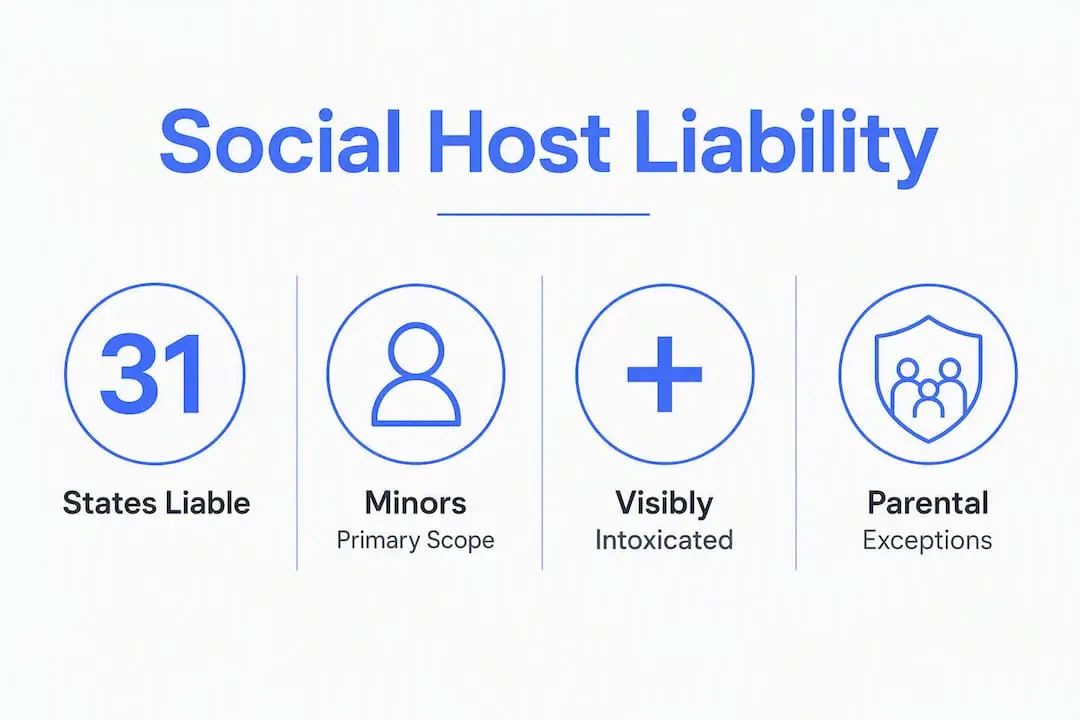
Intoxication standard: Most statutes require that the guest was “visibly intoxicated” or that the host “knew or should have known” the guest was impaired. A few states apply strict liability for minors regardless of visible signs.
Civil liability vs. criminal penalties
The distinction matters because they carry different consequences. Civil liability means a third party (someone injured by your guest) can sue you for damages – bodily injury, property damage, wrongful death, and in some states punitive damages. Criminal penalties, by contrast, are brought by the state and can include fines and jail time.
According to the Insurance Information Institute, social host liability can result in civil suits and, in some states, criminal penalties for furnishing alcohol to minors. The two tracks can run simultaneously: a host could face a criminal charge for furnishing to a minor and a separate civil lawsuit from the family of someone that minor later injured.
The supervised-drinking myth: Prevention First’s Alcohol Policy Resource Center notes that many parents mistakenly believe supervised drinking at home is a safety measure. Social host ordinances exist precisely to counter that assumption – supervised access is rarely a legal defense and often makes liability worse, not better.
Municipalities can also layer on their own rules. Some cities and counties have enacted social host ordinances that are stricter than state law and carry separate fines, sometimes for noise or nuisance violations tied to underage gatherings. Check both your state statute and your local code.
Which states impose social host civil liability?
The National Conference of State Legislatures (NCSL) reports that 31 states allow social hosts to be civilly liable for injuries or damages caused by underage drinkers, and 30 states plus the U.S. Virgin Islands have criminal penalties for adults who host or permit underage drinking parties.
The table below is a compact reference. It was compiled from NCSL’s state chart, state statutes, and public-health resources including Prevention First. Verify the current statute for your state before relying on it – legislatures amend these laws, and a single session can change the scope.
| State | Civil liability? | Main scope | Notes |
|---|---|---|---|
| California | Yes | Minors only (limited adult) | Civil liability for minors; very limited for intoxicated adults |
| Colorado | Yes | Minors | Criminal penalties for adults who host underage drinking |
| Connecticut | Yes | Minors and intoxicated adults | Broad scope; negligence standard |
| Florida | Yes | Minors | Strict liability for minors; limited adult coverage |
| Georgia | No (limited) | Minors (criminal only) | Criminal penalties; civil recovery limited |
| Illinois | Yes | Minors | Dram Shop Act covers commercial; social host statute for minors |
| Indiana | No | Neither (limited) | No general social host civil statute; criminal for minors |
| Iowa | Yes | Minors | Civil and criminal liability for furnishing to minors |
| Kansas | Yes | Minors | Civil liability; parental exception in some circumstances |
| Kentucky | No | Limited | No broad social host civil statute |
| Louisiana | No | Limited | Narrow exceptions; primarily commercial dram shop |
| Maine | Yes | Minors and adults | Broad negligence-based liability |
| Maryland | Yes | Minors | Civil and criminal; parental exception for own minor child |
| Massachusetts | Yes | Minors and adults | Criminal fines and possible jail; civil suits allowed |
| Michigan | Yes | Minors | Civil liability statute; criminal penalties for furnishing |
| Minnesota | Yes | Minors and adults | Broad civil liability; negligence standard |
| Missouri | No | Limited | No general social host civil statute |
| Nebraska | Yes | Minors | Civil and criminal |
| New Hampshire | Yes | Minors and adults | Broad negligence-based liability |
| New Jersey | Yes | Minors and adults | One of the broadest; covers visibly intoxicated adults |
| New York | No (limited) | Minors (criminal) | No general civil social host statute; criminal for minors |
| North Carolina | No | Limited | No civil social host statute |
| Ohio | No | Limited | No general civil social host statute |
| Oregon | Yes | Minors | Civil liability for minors |
| Pennsylvania | Yes | Minors | Civil and criminal; parental exception |
| Rhode Island | Yes | Minors and adults | Broad civil liability |
| Tennessee | No | Limited | No general civil social host statute |
| Texas | Yes | Minors | Civil liability for minors; limited adult coverage |
| Vermont | Yes | Minors and adults | Broad negligence-based liability |
| Virginia | No | Limited | No general civil social host statute |
| Washington | Yes | Minors | Civil and criminal; parental exception |
| Wisconsin | Yes | Minors | Civil liability; criminal penalties |
A note on parental exceptions: Several states carve out an exception when a parent furnishes alcohol to their own minor child on private property. Maryland, Pennsylvania, and Washington are examples. These exceptions are narrow – they typically do not extend to other minors present, and they do not eliminate criminal exposure in all circumstances. Read the exact statutory language before assuming the exception applies.
Method note: This table was compiled from NCSL’s state-by-state chart, state statutes, and Prevention First’s Alcohol Policy Resource Center. It is a general reference only. Consult a licensed attorney in your state for binding legal advice.
How do social host laws differ from dram-shop statutes?
The core distinction is who is serving and why. Dram-shop laws govern licensed commercial sellers – bars, restaurants, liquor stores – that sell or serve alcohol for profit. Social host laws govern private individuals who furnish alcohol in a non-commercial setting without charging for it.
That sounds clean, but the line blurs in practice. Three scenarios show how:
- A house party with a BYOB cooler. The homeowner who stocked the cooler is a social host. Dram-shop law does not apply. Social host liability does, in states that recognize it.
- A house party with a paid bartending service. The host hired a professional. The bartender’s employer may carry commercial liquor liability. But the host can still face social host liability if they directed service, supplied the alcohol, or retained control over who was served.
- A licensed venue with a private buyout. The venue holds the liquor license. Dram-shop liability attaches to the venue for its service decisions. The host may still face social host exposure if they brought outside alcohol, directed service to a visibly intoxicated guest, or otherwise exercised control over the alcohol supply.
Host liquor liability is a separate insurance category from commercial liquor liability. Host coverage is designed for businesses or individuals that occasionally serve alcohol without selling it – a corporate holiday party, a private reception. If a business regularly sells alcohol, it needs commercial liquor liability instead. Misclassifying the coverage type can leave a gap that an insurer will exploit at claim time.
Practical implication for hosts: When you hire a caterer or bartending service, confirm in writing which party controls service decisions and who carries the liquor liability insurance. A contract that assigns service responsibility to the vendor, backed by the vendor’s insurance certificate, is your clearest path to limiting exposure.
Who can be sued, and what exceptions exist?
Courts look at control, not just ownership. Adults who control the premises where alcohol is consumed are the primary targets, but the category is broader than most people assume.
Who counts as a host under most statutes:
- Homeowners and renters who host gatherings at their residence
- Event organizers who arrange and supply alcohol for a private gathering
- Adults who control a rented space – hotel suites, vacation rentals, boats, and chartered buses are all covered in many states
- Parents who allow underage drinking at their home, even when they are not present
The last point catches many people off guard. Massachusetts law specifically addresses parents who permit underage parties, and the criminal penalties there include fines and possible jail time. You do not need to be home for liability to attach – if you own the property and knew or should have known that minors were drinking there, that can be enough.
Common exceptions and defenses
Parental exception: As noted above, several states allow a parent to furnish alcohol to their own minor child on private property. The exception is almost always limited to the parent’s own child and does not protect a host who serves other minors at the same gathering.
Safe-harbor reporting provisions: A handful of states offer limited protection to hosts who call law enforcement when an underage drinking situation gets out of hand. These provisions are narrow and do not eliminate liability — they are closer to a mitigating factor than a full defense.
Good Samaritan provisions: Some states have Good Samaritan laws that protect people who call for medical help during an overdose or alcohol emergency. These are not social host defenses per se, but they can affect criminal exposure in specific situations.
Statutory language is everything. The difference between “knowingly furnishes” and “allows consumption” can change whether a host is liable. A statute requiring that the host “knowingly” served a minor gives a defendant room to argue they did not know the guest’s age. A statute covering anyone who “allows” consumption on their property is much harder to escape. Check the exact wording of your state’s statute.
Pro Tip: If you are hosting an event where alcohol will be present, post a visible sign at the entrance stating that no alcohol will be served to anyone under 21 and that IDs will be checked. It is not a legal shield, but it documents your intent and can support a “did not knowingly furnish” defense.
What are the real penalties if you’re found liable?
The financial exposure from a social host liability claim is not theoretical. Civil damages in catastrophic cases – a drunk-driving fatality caused by a guest who left your party – can reach into the millions. Courts can award:
- Compensatory damages: Medical bills, lost wages, pain and suffering, and property damage for the injured party.
- Wrongful death damages: In fatal cases, the victim’s family can sue for loss of financial support, funeral costs, and loss of companionship.
- Punitive damages: Some states allow punitive awards when the host’s conduct was reckless or willful. These are not capped by the underlying harm and can dwarf compensatory awards.
On the criminal side, Massachusetts is a concrete example: furnishing alcohol to a person under 21 is a criminal offense carrying fines and possible jail time, separate from any civil suit. Other states with criminal social host provisions follow similar structures.
How homeowners insurance responds
Most homeowners policies include personal liability coverage, but the limits are often inadequate for a catastrophic alcohol-related claim. The Insurance Information Institute cites typical homeowners liability limits as $100,000–$300,000, which can be insufficient when damages involve serious injury or death.
Pro Tip: Ask your insurer specifically whether your policy includes a host liquor liability endorsement and whether it excludes coverage for criminal conduct. A standard homeowners policy may deny coverage entirely if the host faces a criminal charge for furnishing to a minor – leaving you to defend a civil suit out of pocket.
Two additional coverage issues to know:
- Host liquor vs. commercial liquor liability. If you are a business hosting an occasional event, host liquor coverage (often an endorsement on a commercial general liability policy) may apply. If your business regularly serves alcohol, you need a standalone commercial liquor liability policy. Alliance Risk’s guidance on liquor liability makes clear that misclassifying the coverage type can leave gaps at claim time.
- Excess liability/umbrella policies. For larger events, consider a personal umbrella policy that sits above your homeowners coverage. Umbrella policies typically start at $1 million in additional coverage and are relatively affordable for the protection they provide.
Concrete steps to reduce your exposure before and during an event
Risk reduction is not complicated. Most of it comes down to controlling service, documenting what you did, and transferring responsibility where you can.
- Verify ages at the door. Check government-issued photo ID for every guest whose age is not certain. Keep a sign-in sheet or a photo log of IDs checked.
- Stop serving visibly intoxicated guests. Train anyone helping with service – including yourself – to recognize the signs of intoxication and refuse further service. “One more won’t hurt” is the sentence that precedes most liability claims.
- Cut off service early. Stop alcohol service at least 60–90 minutes before the event ends. Give guests time to sober up before they drive.
- Provide food and nonalcoholic alternatives throughout. Food slows alcohol absorption. Offering mocktail options alongside alcoholic drinks gives guests a real choice and signals that you are running a responsible event.
- Arrange safe transportation. Pre-book rideshare codes, designate sober drivers, or offer a place to stay overnight. Put the options in writing and share them with guests before the event.
- Document everything. Photograph posted signage, keep vendor contracts, save guest lists, and write down any incident notes immediately after the event. If your venue has CCTV, preserve the footage.
- Hire licensed professionals. A licensed bartending service brings trained staff, formal ID-check protocols, and their own insurance. Hiring professional bartenders shifts service decisions to people trained to make them.
- Require certificates of insurance from vendors. Any caterer or bartending service you hire should provide a certificate of insurance naming you as an additional insured, plus a written contract that assigns service responsibility to them.
Pro Tip: Ask your bartending service for a written service agreement that explicitly states they are responsible for ID verification and refusal-of-service decisions. That contract language is evidence in any future dispute about who controlled the alcohol service.
For larger or corporate events, a vendor checklist that covers insurance, contracts, and service protocols is worth building before you book anyone.
Why a licensed bartending service changes your risk profile
Consider a common scenario: a host hires an unlicensed friend to pour drinks at a birthday party. A guest becomes visibly intoxicated, drives home, and causes an accident. The host supplied the alcohol, the “bartender” had no training and no insurance, and the host retained full control over the service environment. Every element of social host liability is present.
Now change one variable: the host books a licensed bartending service with a written contract, a certificate of liquor liability insurance, and staff trained in responsible service. The bartender refuses to serve a guest who shows signs of intoxication, calls the host over to explain the refusal, and logs the incident. If a claim later arises, the host has documentary evidence of a professional service protocol, a vendor with their own insurance, and a clear contractual assignment of service responsibility.
Industry experts consistently identify hiring professional bartenders as one of the most effective risk-management steps available to private hosts, precisely because trained servers check IDs, refuse service to intoxicated guests, and carry their own insurance.
What to verify before booking any bartending service
- Proof of liquor liability insurance: Ask for a certificate of insurance, not just a verbal assurance. Confirm the coverage amount and that it is current.
- Responsible Beverage Service (RBS) training: In California, RBS certification is legally required for alcohol servers. In other states it is a best practice. Ask whether staff hold a recognized certification such as TIPS (Training for Intervention ProcedureS) or ServSafe Alcohol.
- Written service contract: The contract should specify who is responsible for ID checks, refusal-of-service decisions, and incident reporting.
- References from similar events: A bartending service that has handled events of your size and type will have protocols for the situations that actually arise.
- Nonalcoholic options: A service that offers elevated mocktails alongside cocktails makes it easier to keep guests comfortable without alcohol, which reduces overall consumption and risk.
Pro Tip: Before signing any vendor contract, read the indemnification clause. A well-drafted clause should state that the bartending service indemnifies you for claims arising from their service decisions. If the contract is silent on indemnification, ask for it in writing before you sign.
For guidance on what to look for when hiring a bartender for a private party, the vetting criteria above are a solid starting framework.
When should you call an attorney?
Most hosts will never face a claim. But certain events should trigger a call to a licensed attorney in your state before you say or do anything else.
Call an attorney immediately if:
- A guest was seriously injured or killed after leaving your event
- You receive a demand letter from an attorney representing an injured party
- Law enforcement contacts you about an incident connected to your event
- You are served with a lawsuit or named in a complaint
- A minor was involved in an alcohol-related incident at your gathering
- Your insurer denies coverage or reserves its rights on a claim
Immediate steps to protect your legal position:
- Preserve all evidence. Do not delete texts, emails, photos, or social media posts related to the event. Save vendor contracts, receipts, and any written communications.
- Notify your insurer promptly. Most policies require timely notice of a potential claim. Delayed notice can give an insurer grounds to deny coverage.
- Do not give detailed statements without counsel. A brief, factual account to law enforcement may be unavoidable, but detailed statements to opposing attorneys or adjusters should wait until you have legal advice.
- Collect witness information. Names, phone numbers, and a brief note of what each witness observed – gathered as soon as possible, while memories are fresh.
- Document the incident in writing. Write down your own account of the event, including the timeline of alcohol service, any refusals, and what you observed about the guest’s condition. Date it and keep it private until your attorney reviews it.
- Check your policy’s pre-approval requirements. Some policies require the insurer to pre-approve legal counsel. Hiring an attorney without that approval can affect reimbursement.
This article is general information, not legal advice. Social host liability laws vary by state and change frequently. Consult a licensed attorney in your state for advice specific to your situation.
Key Takeaways
Social host liability applies in most U.S. states, and a single alcohol-related incident at a private party can expose a host to civil damages, criminal penalties, and insurance gaps that standard homeowners coverage may not fully address.
| Point | Details |
|---|---|
| State law varies significantly | 31 states allow civil liability for social hosts; check your state’s specific statute before hosting. |
| Minors vs. adults scope | Most states cover minors; fewer extend liability to visibly intoxicated adults — know which category your state uses. |
| Insurance limits matter | Typical homeowners liability limits cited in guidance are $100,000–$300,000, which can be insufficient for catastrophic cases; verify endorsements with your insurer. |
| Documentation reduces exposure | Log ID checks, service cutoffs, vendor contracts, and any incidents in writing at the time they occur. |
| Cocktail-crew shifts service risk | Booking a licensed bartending service like Cocktail-crew puts trained, insured professionals in charge of service decisions. |
Hospitality and legal duty are not opposites
The framing that “responsible hosting” and “great parties” are opposites is wrong, and it leads hosts to make worse decisions in both directions. Hosts who think liability is someone else’s problem skip the steps that would actually protect them. Hosts who are scared of liability sometimes overcorrect into joyless, over-managed events that nobody enjoys.
The practical reality is simpler: most of what reduces your legal exposure also makes for a better event. Stopping service before guests are visibly impaired, offering good food and nonalcoholic options, and having a professional handle the bar are not legal chores. They are the marks of a host who knows what they are doing.
What most guides understate is how much the vendor relationship matters. A licensed bartending service is not just insurance paperwork. It is a trained person at the bar who has refused service to a thousand guests before yours and knows how to do it without creating a scene. That experience is not something a homeowner with a cooler of beer can replicate, no matter how good their intentions.
The states that impose the broadest social host liability – New Jersey, Connecticut, Minnesota, Vermont – are not outliers. They reflect where the law is trending. If your state does not currently impose civil liability for serving intoxicated adults, that does not mean it never will, and it does not mean you face zero risk. A negligence claim can still proceed in many jurisdictions even without a specific social host statute, if a court finds the host’s conduct was unreasonable.
Check your state law. Hire professionals when the stakes are high. Document what you did. Those three steps cover the vast majority of the risk.
Cocktail-crew: professional bartenders who carry their own coverage
Knowing your legal exposure is step one. Doing something about it is step two. Cocktail-crew provides licensed bartenders for private events – birthdays, weddings, corporate gatherings – with a minimum booking of just three hours, so you are not locked into a full-day contract for a smaller event.
Every Cocktail-crew bartender is trained in responsible service, handles ID verification, and knows when to cut off service. The service includes a written contract, proof of liquor liability insurance, and optional mocktail menus for guests who are not drinking. That combination – trained staff, documented protocols, and vendor insurance – is exactly what shifts service control away from you and onto professionals who do this for a living.
To see what professional bartending can do for your event and to check availability for your date, visit Cocktail-crew’s booking page or reach out for a quote.
Useful sources and further reading
The following sources were used to compile this guide and are recommended for further research. Always verify current statutory language directly with your state’s legislature or a licensed attorney.
- NCSL: Social Host Liability for Underage Drinking Statutes – The National Conference of State Legislatures’ state-by-state chart of civil and criminal social host statutes; the primary reference for the state table above.
- Prevention First: Social Host (Alcohol Policy Resource Center) – Public-health context for why social host laws exist, including the supervised-drinking myth and municipal ordinance variations.
- Insurance Information Institute: Social Host Liability – Covers civil vs. criminal outcomes, homeowners insurance limits, and responsible-host frameworks.
- Mass.gov: Social Host Law Information for Parents – A concrete example of state-level criminal and civil penalties; useful as a benchmark for what statutory enforcement looks like.
- Wikipedia: Social Host Liability – A useful overview of the doctrine’s origins in statute and case law across U.S. jurisdictions.
- Alliance Risk: Liquor Liability Insurance – Explains the difference between host liquor and commercial liquor liability coverage and common misclassification risks.
- Insurance Technical Consulting: Host Liquor Liability – Industry-level guidance on hiring licensed professionals and what to verify in vendor contracts and insurance certificates.
- MADD (Mothers Against Drunk Driving) – Advocacy and public-safety resources on drunk driving prevention; relevant background for understanding the harm social host laws are designed to prevent.
- NIAAA Alcohol Policy Information System – The National Institute on Alcohol Abuse and Alcoholism’s policy database, which tracks state-level alcohol laws including social host provisions.
- Cocktail-crew: Private Event Bartending – Information on hiring licensed bartenders for private events, including service terms and coverage documentation.
- Jaks Party Power: Why Professional Setup Ensures Party Safety – Supplemental resource on professional event setup and safety protocols for private hosts.
Legal disclaimer: This article is general information only and does not constitute legal advice. Social host liability laws differ by state and are subject to change. Consult a licensed attorney in your jurisdiction for advice specific to your circumstances.
Frequently Asked Questions About Social Host Liability
1. What is social host liability?
Social host liability refers to the legal responsibility a person may face for serving or providing alcohol to guests who subsequently cause harm to themselves or others. The rules vary by state, and liability depends on the circumstances of the incident and applicable law.
2. Can a party host be held liable if a guest drinks and drives?
In some circumstances, a party host may face legal liability if a guest drinks alcohol at their event and later causes a drunk-driving accident. However, the outcome depends on state law, the host’s conduct, the guest’s age, and other relevant facts.
3. Do social host liability laws vary by state?
Yes. Social host liability laws differ across the United States. Some states impose liability in specific situations, such as serving alcohol to minors, while others may limit a private host’s responsibility for injuries involving adult guests. Check the laws applicable to your state.
4. Does homeowners insurance cover social host liability?
A homeowners or renters insurance policy may provide some liability coverage for certain alcohol-related incidents, but coverage depends on the policy wording, exclusions, and circumstances. Review your policy with your insurance provider to understand your coverage.
5. How can I reduce social host liability risks at a party?
Hosts can take practical steps to promote responsible alcohol service, including checking guests’ ages where required, avoiding service to visibly intoxicated guests, providing non-alcoholic drinks, arranging safe transportation, and preventing underage drinking. These precautions can reduce risks but do not guarantee immunity from liability.
6. Does hiring a professional bartender eliminate social host liability?
No. Hiring a professional bartender does not automatically eliminate a host’s legal responsibility. A trained bartender can help manage alcohol service responsibly, but liability depends on applicable law, the service arrangement, and the facts of the event.